Resurfacing

Please allow me to fill in the blank space between early July and late August. First off, I have to say I thought it had been much longer than that since I had written anything here. This last month was a long year.

Sometime back in June we learned that the mega-pharmacy chain we had been using was going to close and all our prescriptions would be shifted to another mega-pharmacy chain unless we specified somewhere else for them to go. This would have been our third mega-pharmacy chain, and really there isn’t much difference between them, but this one was a bit further away than was convenient so we instead had all our prescriptions transferred to the pharmacy at a mega-grocery chain that is closer to where we live. The kind of choice in the consumer market our government’s economic policies have worked for years to achieve.

I want to take a moment here to talk about the Swiss Cheese Problem. This is a topic of frequent conversation in health care and, I suspect, management circles in other high-risk professions as well. We’re all human and everyone makes mistakes, like the holes in a slice of Swiss cheese. You’re never going to get rid of those holes in the individual slices so what you do is, you build systems that stack slices on top of one another. If something falls through the hole in one slice, it gets caught by the one below it. The difficulty is, every now and then, by sheer chance all the holes in the individual slices line up and something drops clean through. This is the situation I found myself in over the last month.

The pharmacy that was closing was supposed to transfer my prescriptions. They didn’t. The new pharmacy insisted that I had picked up a refill of my medication. I hadn’t. During all this, Dr. Psychiatrist was out of the office and unavailable. The result of all this was that I was out of my heavy-hitter antidepressant for about a month, and out of all my medications for 2-3 weeks. I have been on at least one antidepressant for at least ten years so facing reality without any kind of chemical filter was challenging. Also, in addition to two different medications that help turn down my sympathetic (fight-or-flight) nervous system, I have been taking a combination serotonin–norepinephrine reuptake inhibitor (SNRI) / norepinephrine-dopamine reuptake inhibitor (NDRI). The physical withdrawal symptoms were rough.

The good news is, all the medication issues are resolved and I have a reasonable supply of everything again. The automatic refill service at the mega-grocery chain pharmacy even seems to work, which is nice. The bad news is, I have essentially been starting from zero with all my medications again. I am feeling much better and much more stable than I was but Dr. Psychiatrist estimates I have another couple of weeks before I’m back at a steady state.

Best healthcare system in the world.
Click?

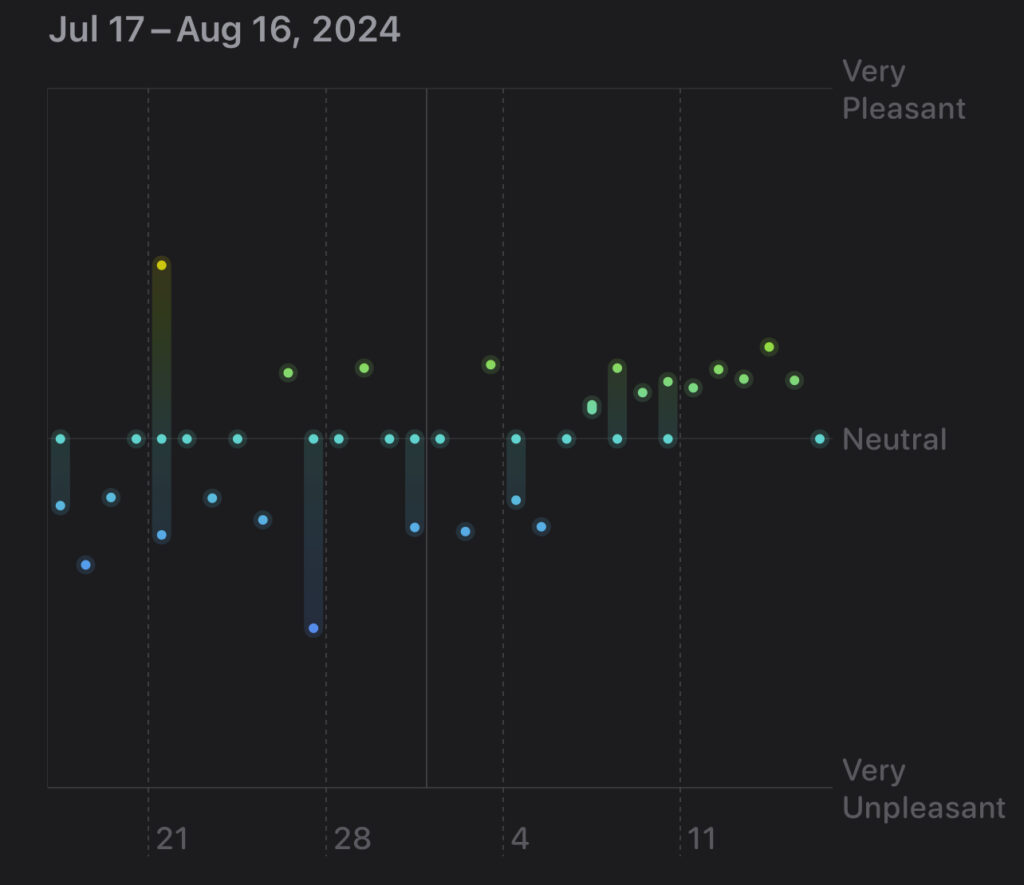
I have been intending to post about this for several days now and here I am, finally getting to it. I referred previously to getting trans-cranial magnetic stimulation, or TMS, therapy. If you had asked me how I thought it was going a few weeks ago, I would have said I thought it was helping with my anxiety symptoms, especially the hyper-alertness. Not game-changing but certainly worth pursuing. Two weeks ago, something clicked. Let me preface this by saying in the intervening time things have settled back down closer to, but still above, my previous baseline but for a few days there, my brain was working, possibly better than it ever has.

When I say something clicked, I really do mean the change was almost instantaneous. I was walking along in my usual depressive funk then, as best I can describe it, an instrument panel got plugged in. I could monitor and regulate things I hadn’t even been aware of that affected my mood. “What kinds of things?”, I hear my excited audience ask. Therein lies the problem. I’ve referenced the original Star Trek episode Spock’s Brain before, the relevant part being Dr. McCoy using the alien hair-dryer to learn how to put Spock’s brain back in and his amazement at how simple the procedure is, once he already knows how to do it1. Of course, as time goes on, the effects of the magic hair-dryer start wearing off and McCoy, mid-procedure, realizes how complex it is and that he no longer has any idea what he’s doing. Très dramatique. All this is to say, I feel like I’ve lost that level of admin access and I’m not sure how I was making it all work.

For those few days though, I felt invulnerable. I bumbled through life feeling vaguely cheerful. I had fun doing things I enjoyed2. The closest I’ve ever come to that before was the first time I started taking antidepressants3. While things have pulled back somewhat, I still feel considerably better than I have for quite some time

As long as I stay in the house, don’t go anywhere, or do anything. Baby steps, I suppose.


  1. If you prefer a more high-brow reference, you can think of this as being my Person on business from Porlock ↩︎
  2. I told my therapist I wanted to go back and revise every PHQ-9 I’d done for the last three years. I have a much better understanding of the “Little interest or pleasure in doing things” question now. ↩︎
  3. For the curious, it was sertraline and I think it was somewhere in the early 2000s? Maybe? That I’m not so sure about. ↩︎

Since I Have a Moment

It is currently stormy AF outside and the power keeps blinking. I usually1 sleep with two white noise machines going, and music playing in order to keep me from hearing things at night and waking up. The difficulty is, of course, that the white noise machines shutting off wakes me up, so I turn them back on and go back to sleep. Then the power blinks again. You get the idea.

Anyway, through the miracle of battery technology, I might as well take advantage of this unexpected up-time instead of just lying in bed and seething2. So what has been going on in my head?

The most confusing bit for me is that I feel both better and worse than I did, say, six months ago. I feel better because my mood is generally more stable (for the last few weeks anyway) thanks to getting a combination of meds that seems so work, having a therapist who is good at his job, and transcranial magnetic stimulation treatments3. On the other hand, the world in general, and the United States in particular, have managed to engineer a set of circumstances that are similar enough to the winter of 20204 that my PTSD is on Extra-Jumpy mode. I think I’m coping with the increased symptoms better than I would have if I didn’t have a few things working in my favor but it still isn’t much fun.

The coping methods include, picking up writing again5, and aggressively ignoring as much of the outside world as I can for the time being. I assume someone will let me know if any of the four or five things swirling around that could cause another pandemic actually does.


  1. This is a habit left over from working night shift. I have needed to continue doing it because I tend to be jumpy enough that nearly anything will wake me up. ↩︎
  2. I’m still seething but I’m not doing while lying in bed and I’m also doing something else, which makes the seething better somehow? I don’t know how these things work. ↩︎
  3. More on this when it isn’t 0330 during a windstorm. ↩︎
  4. I’m not going to go into a detailed list of the similarities between today and 2020 and today because it would likely cause my brain to spiral. It’s all the things you would think would be on the list and a few things that might be a bit more obscure. ↩︎
  5. No “I told you so”s from the peanut gallery, please ↩︎

Great Way to Spend a Friday

For reasons that aren’t relevant to the rest of the story1, we spent a good portion of Friday night/early Saturday morning in the ER at Highline or whatever teh fook CHI rebranded it to.

I’m not really sure what I want to say about this. It was horrible, of course. Being in health care environments still is quite difficult. Highline uses the same cardiac monitors and IV pumps as most of the other hospitals I’ve worked in recently so there were lots of very familiar sounding beeps and alarms. By the time Shannon was discharged I was about ready to crawl out of my skin.

Today is Wednesday and I still don’t feel like I’ve entirely put myself back together yet. This is yet more evidence that going back to work in health care is definitely not in the cards, at least for the foreseeable future.

As mentioned, my brain is full kind of scrambled. It’s difficult to string thoughts together. I may try this again in a couple of days.

Edited to add – Somehow I managed to turn on a function I didn’t even know WordPress had, subscriber only access. If anyone visited earlier and got a subscriber only notice let me offer my sincere apologies. I don’t know why anyone reads this in the first place and I certainly don’t want to make it any more difficult to access.

  1. Shannon was having issues with her chronic pain left over from cancer treatment. She’s back to baseline now. It’s not like any of this or secret or anything but I’m lazy and don’t feel like typing out all the background context. If you want details feel free to ask her and I’m sure she’ll fill you in. ↩︎

It’s a Process?

As I have mentioned, something I’ve been learning, slowly, is I can’t ignore things anymore. I was really good at ignoring things. So good, in fact, I assumed that I was letting things go and moving on instead of continuing to drag all these things behind me. I had another example of this phenomenon over the weekend.

In the interest of providing full context, I am going to confess to something that will likely make more than one of the people reading this make the Look of Disapproval ಠ_ಠ. Due to very typical glitches in The Best Health Care System In The World™, I ran out of eszopiclone (brand name Lunesta) which Dr. Psychiatrist prescribed to help me sleep1. I was out of it for about a week and finally got it filled again on Wednesday or Thursday of last week. Keep in mind, I’ve been chronically sleep deprived for probably 30 years, so I assumed a few days with disrupted sleep was not going to have that much of an impact.

Another item on the list of things I didn’t think would matter was anniversaries. October 0f 2020 was close to the peak of my mental health implosion. The significance of anniversaries for PTSD is something that falls into the “Know vs. Believe” category for me. I have been assured by multiple sources who all know way more about these things than I do that your brain keeps track of these things and they can potentially be quite disruptive. The part of my brain that understands science knows this to be true. The part of my brain that doesn’t really believe there is anything wrong with me in the first place rejects this idea. As has been pointed out in other contexts, science doesn’t really care if you believe it, anniversaries appear to affect me whether my brain wants to admit it or not.

On Saturday, in the midst of these two things both of which I was firmly convinced were not affecting me at all, I took on something of an emotionally charged task. This was a project I had been dreading taking on for some time and had a number of factors, rational or not, that had built it up to something quite intimidating in my mind. It turns out this was probably not a good idea. I was an absolute basket case on Sunday and only started feeling like my brain was functional again Monday afternoon.

What I have learned from this experience is, I really do have to pay attention to my own state before I dive into anything. Not only that, I have to have enough on the ball to say, “I have too much going on, I can’t take on anything else right now”. My previous history has not provided me much experience with doing this.


  1. As an aside, I want to sing the praises of eszopiclone. My relationship with sleep aids is peculiar. Anything I have tried previously has either not worked at all, or worked too well. The last medication Dr. Psychiatrist tried, doxepin, turned me into a zombie for 24 hours on the lowest available dose. When I was working, the solution was to turn to medications to promote wakefulness instead of trying to help me get more sleep. Eszopiclone has been flat-out miraculous. My sleep patterns on this drug have been more normal than they have been, possibly ever. I sleep 6-8 hours, I’m a little dopey in the mornings, and then I’m pretty much a normal human. I have REM sleep every night. It’s astonishing. ↩︎

Clever Title

It turns out Dr. Psychiatrist is very likely correct in that I have found a plateau of stability with my current medication regimen. There are unquestionably still some bumps that need to be smoothed out. I still startle at just about any unexpected noise, although this is better than it was previously. I still have occasional episodes where I see or hear something three or four conceptual jumps from anything hospital related, my brain immediately decides to make those jumps, and settles on “Hey, isn’t this just like [$awful_thing]”? No, it really isn’t like [$awful_thing]. In fact it isn’t connected at all. Thanks for bringing it up though, because now all I can think about is [$awful_thing]. My brain is not particularly helpful a lot of the time. And, of course, I still can’t seem to tolerate being out in public for more than 2-3 hours. On the up side, the first hour or so seems to be getting a bit easier but when it’s time to go, it is still time to go.

Bumps aside, this calming of the inner turmoil has allowed me a bit more clarity than I have perhaps had in the past, which brings me to the point of this particular post1. I am improving, and I continue to improve, but I am not doing it quickly. Also, there really isn’t much I can do to speed up the process. It has been brought to my attention that putting pressure on myself to recover may, in fact, be counter-productive. This is a realization that has been growing for a while now and I am only starting to really grasp what it means.

Among the more obvious sequelae of not being able to hurry recovery is the effect it has on my prospects of returning to work. Previously, as recently as this summer, I had been operating under the assumption that when it came right down to it, and I had used up all the resources that have been made available to me, if I wasn’t ready to go back to work I would sweep everything under the carpet again and just go do it, much like I have in the past when I was feeling run down and burned out. What I have come to realize is, this is how I ended up here in the first place. There is no room under the carpet anymore and I can’t keep trying to sweep stuff under there. Not “can’t” as in “shouldn’t for my mental health”, “can’t” as in “am actually unable to”. I find that I can’t2 ignore things anymore, which may also explain why I jump every time there’s a noise.

I know I have posted about how I never really understood how people who survive disasters could describe themselves as lucky3. If you were lucky, your house wouldn’t have been hit by a tornado. My difficulty was misunderstanding the word. You can have Win The Lottery luck, or you can have I Didn’t Die luck. I bring this up because I am incredibly lucky4 in that I have a great many supportive people in my life. The time will come, sooner rather than later I suspect, when I’m going to have to lean on the people in my life even heavier than I am already.


  1. Penalty; unnecessary alliteration. Five word penalty and repeat the paragraph. ↩︎
  2. See previous discussion on the intended sense of the word “can’t” ↩︎
  3. Nope. Still not going to go back and look up which post it was. It’s back there somewhere. ↩︎
  4. In the I Didn’t Die sense of the word. Again, in the I Won The Lottery sense I wouldn’t be in this position to start with. With as vague as this goddam language is, it’s a wonder anyone can communicate at all. ↩︎

Medication Roundup

All I know is the steak tastes better, when I take my steak taste better pill

My regular appointment with Dr. Psychiatrist was today. I’ve been checking in with her regularly while medications are being adjusted. The good news is, there are no more adjustments planned. The bad news is, I have to do the rest of the work myself.

The only part of the current regimen I find unusual is the dextromethorphan. As previously mentioned1, it’s part of a recently approved combination with bupropion. It has a brand name, but the brand name is somehow harder to remember and pronounce than dextromethorphan/bupropion. At some point I intend to look up how teh fook it’s supposed to work and, perhaps more curiously, why someone decided to try a cough suppressant to treat anxiety. I have not, however, done anything about it. it’s not high on the priority list.

I think Dr. Psychiatrist is likely correct in that I’m probably about as stable on meds as I’m likely to get. Life still needs to get easier and who doesn’t wish for a magical cure-all pill. The challenge is remembering I can’t try to fix everything else all at once.

Edited to add – Doing things, and fixing things. These are vague to the point of uselessness so I’ll try to narrow it down a bit. Doing things would mostly include activities outside the house. Shopping and such. The ultimate goal would be something outrageous like being able to hold a job. Fixing things at this point mostly means putting the environment back together after two years of the entire house turning into a depression nest. Both of these things are requiring different approaches than they have in the past and it’s a bit of an adjustment.


  1. I know it was only a few posts back but I’m still not going to bother looking it up. Scroll back a bit and I’m sure you’ll find it. ↩︎

Further Thoughts on Objective(?) Data(?)

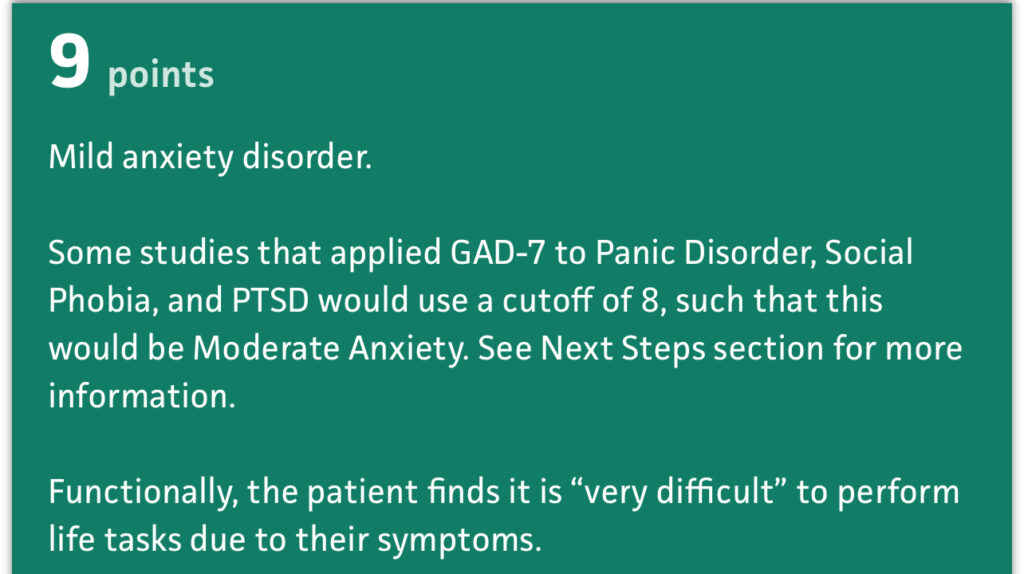
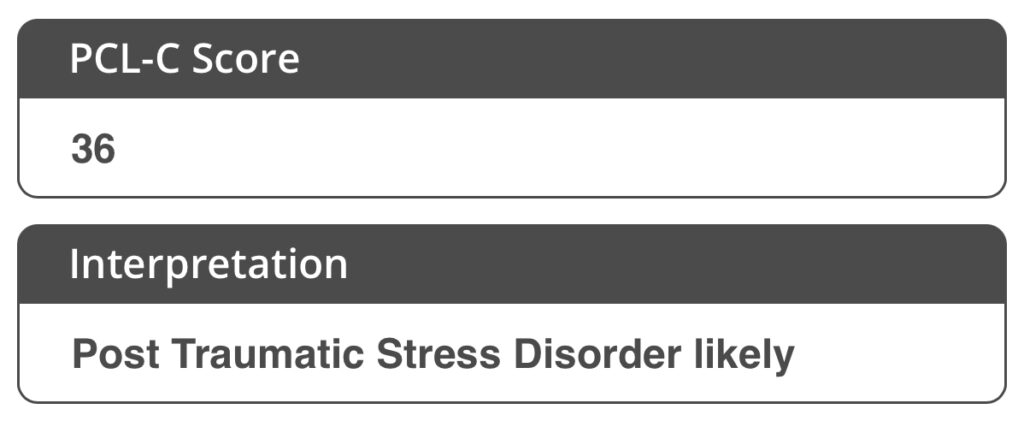
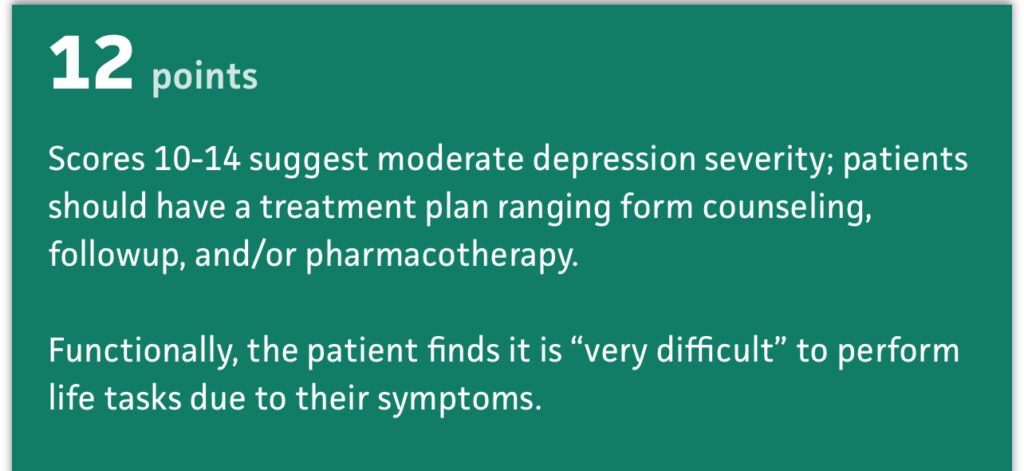
Once again exposing some bias or another1 in my thinking, I assumed everyone knew what the PHQ-9, GAD-7, and PCL-C were and how they worked. I may have even explained here at some point. or maybe I didn’t…

Anyway, the point is, I want to give a quick explanation of what they are and how they work.

All three of these are screening tools for various mental health diagnoses. The Patient Health Questionnaire-9 (nine questions) and Generalized Anxiety Disorder-7 (seven questions) especially were designed for primary care providers to use to screen all their patients for depression and anxiety. The PCL-C2 is the civilian version of the PTSD screening tool developed by the military to screen troops. They rely on the frequency of symptoms like anhedonia, feelings of isolation or disconnection from others, nightmares, etc. as reported by patients. They were designed to be used by health care professionals and their patients in the setting of a therapeutic assessment. They were never intended to be self-administered, and certainly not self-interpreted. I am, in short, using them wrong3 and the numbers may or may not mean anything.

They’ve been scientifically validated and are relied upon by experts in the field so I’m more or less obligated to accept them as valid. When used as intended. I tend to have fairly concrete thinking when it comes to health care so having any kind of number to look at makes things easier. Whether or not the numbers are actually useful is a different question.


  1. I’ve never been clear on which of my many neuroses causes this to happen but for whatever reason I commonly assume that if I know something, everyone else must know it too. It was something I was consciously trying to change when I was working on my education degree and have, clearly, fallen out of the habit. ↩︎
  2. I’ll be honest, I have no idea what this stands for and I’m not going to bother to look it up. ↩︎
  3. Considering the disdain I hold for people who use the internet to diagnose themselves with various things, this may come off a bit hypocritical. I thread that needle in my mind by asserting my (still valid) credentials as a health care professional and that these are being used in the setting of receiving treatment for the relevant disorders. Hopefully I can swing a bit more nuance than someone lacking the appropriate organs diagnosing themselves with uterine fibroids. ↩︎

I’m Still Alive

Vicious circles are something I’m really good at. I’ve been feeling anti-social1, and I have a distorted view of my position in society which tells me if I’m not actively engaging, people tend to forget I exist2. This, of course, makes me feel even more anti-social.

On the up side, I do think my new combo med with dextromethorphan does seem to be helping with my generalized anxiety, and I continue to sleep reasonably well.

I suppose what this comes down to is another request to continue to bear with me, which I already know everyone will. Even if I don’t respond to texts, or comments, or phone calls, I read and appreciate the content. Not responding doesn’t mean I don’t care or I’m not paying attention, I’m just being Oscar the Grouch.


  1. Obligatory quote from St. Swithin’s Day by Grant Morrison – I’m not anti-social, society is anti-me. ↩︎
  2. This is not fishing for compliments. I’m aware people seem to think I have many redeeming qualities, the difficulty is I haven’t entirely persuaded my brain to believe it yet. This is a work in progress. ↩︎