Gotta keep those goals achievable…
Gotta keep those goals achievable…
Rational people who discuss the relative quality of Christmas movies (a rather small subset of people) almost universally1 agree that the two main candidates for the greatest Christmas movie of all time are Lethal Weapon and Die Hard. I acknowledge the argument for making a distinction between Christmas Movies and movies that take place during Christmas but that is a debate for another day.
What I want to talk about today is the inclusion of a third candidate for greatest Christmas movie of all time; The Lion in Winter (1968).
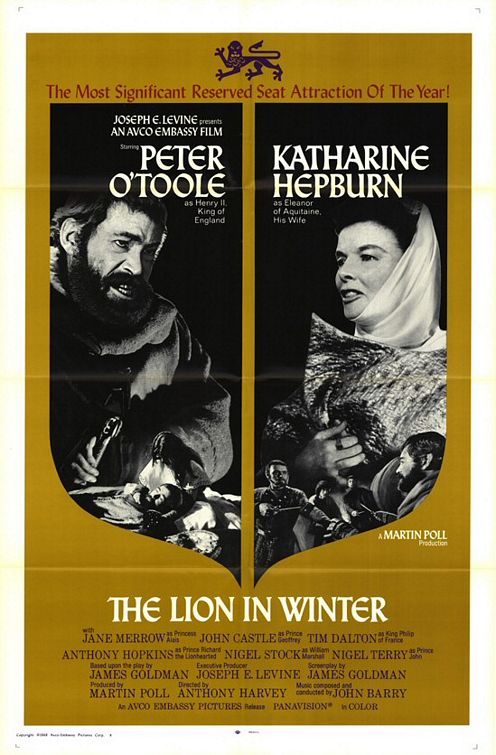
Based on the play of the same name by James Goldman, and adapted by him as well, the movie tells the story of Henry II of England’s Christmas court in 1183, and the interpersonal and political dramas among Henry, Eleanor of Aquitaine, their children, and their guests.
The script runs the whole emotional spectrum over the course of the movie and is full of sharply funny and poignant dialogue. The cast is full of enough heavyweight actors that it bends light2 and even the soundtrack is extraordinarily good.
It is not a perfect film by any stretch. The directing and cinematography are not great, by modern standards at least, but it is still a towering achievement that easily deserves consideration as a Christmas classic.
—-
1 I would argue that disagreeing with the idea of those two movies being among, if not at the top of the list could almost certainly be used as evidence that would exclude someone from the “rational” category.
2One of the more enjoyable parts of the movie for me is Katharine Hepburn’s performance. She plays Eleanor of Aquitaine, who was notoriously French, but not only does she makes absolutely no attempt at a French accent, she doesn’t even make any attempt to conceal her own, quite broad, East Coast/New England accent (in her first scene she mentions that she’ll be attending a “Christmas co-aaht”). In spite of that she gives a performance so compelling that it almost pulls you into the screen.
This is another one of those musical finds that more or less randomly dropped into my lap. I’ve been listening to a lot of music lately. I listen to music while I’m doing homework, I listen to music while I’m doing contract tracing, I listen to music when I’m trying to settle my brain before bed. I have pretty extensive music collection but looked at from a broad perspective there are really only five or six genres of music represented and recently it’s all been feeling a little stale.
Some time ago, and I can’t even remember where I heard about it, I downloaded the Boomplay app. For those not familiar, Boomplay is kind of Spotify for the African continent. My exposure to afro-pop is limited to the very small collection of artists that have broken in to the U.S. market to some extent so I was expecting to be able to find something new and (hopefully) interesting.
In one of those tiny sparks of serendipity, the first song that was playing when I switched it on was this
Angélique Kpasseloko Hinto Hounsinou Kandjo Manta Zogbin Kidjo is a musician, actor and activist who was born in Benin in West Africa and that is the extent of what I know about her.
In 2018 she released a cover of Remain In Light by the Talking Heads. The whole album.
It. Is. Amazing.
One of the best ways to get me hooked into a song is to take an element that is familiar and transforming it into something very different, DJ Shadow using a sample from El Condor Pasa (If I Could) in You Can’t Go Home Again, for example, or Diane Birch’s Velveteen Age EP. Remain In Light is one of my favorite Talking Heads albums (along with almost all the others if I’m honest) and it works surprisingly well as an afro-pop album. It is also unquestionably something different, even if all the songs are more than 40 years old at this point.
At some point in the near future, once I’m able to stop compulsively listening to this album, I want to dig in to some of her other material. I’m hoping more discoveries await.