July 4

I am not going to delve into the irony of celebrating the independence of the United States from England while the country is busily installing our first king ourselves. Anyone likely to be reading this shares the same existential dread I do but that is a different conversation. What I want to talk about today is explosions.

I don’t know if the brain-stem level enthusiasm for blowing things up is uniquely American or something that is just a product of the recklessness of youth but either way, people just don’t let up. Fireworks are, as far as I know, illegal county-wide now but that doesn’t really seem to have discouraged anyone.

The hypocrisy coming off this post is obscuring my screen, so allow me to justify my change of stance. Not just change, I suppose, but polar reversal. I was as mindlessly enthusiastic about blowing stuff up in my youth as anyone and, like most American males, the recklessness of youth lasted well into my 30s. Since then, however, I have had a number of experiences which have led me to change my position. The key experiences, unsurprisingly, were working in an ER, developing a hyperactive startle response1, and owning a dog. As I have aged the risk to my own personal fingers, toes, ears, and nose has diminished considerably of course but one still has a certain sympathy for the people who will spend the rest of their lives, starting tomorrow, unable to count to twenty unassisted. The startle and the dogs continue to be an issue in the household. Having a ninety pound dog trying to hide underneath you because some yabbo in the street set off a firecracker is a unique experience.

I suspect nothing is going to change how my fellow Americans choose to celebrate their rapidly vanishing freedoms so if anyone needs me I will be hiding under the bed with the dogs.


  1. It is possible that these two things are related. ↩︎
Since I Have a Moment

It is currently stormy AF outside and the power keeps blinking. I usually1 sleep with two white noise machines going, and music playing in order to keep me from hearing things at night and waking up. The difficulty is, of course, that the white noise machines shutting off wakes me up, so I turn them back on and go back to sleep. Then the power blinks again. You get the idea.

Anyway, through the miracle of battery technology, I might as well take advantage of this unexpected up-time instead of just lying in bed and seething2. So what has been going on in my head?

The most confusing bit for me is that I feel both better and worse than I did, say, six months ago. I feel better because my mood is generally more stable (for the last few weeks anyway) thanks to getting a combination of meds that seems so work, having a therapist who is good at his job, and transcranial magnetic stimulation treatments3. On the other hand, the world in general, and the United States in particular, have managed to engineer a set of circumstances that are similar enough to the winter of 20204 that my PTSD is on Extra-Jumpy mode. I think I’m coping with the increased symptoms better than I would have if I didn’t have a few things working in my favor but it still isn’t much fun.

The coping methods include, picking up writing again5, and aggressively ignoring as much of the outside world as I can for the time being. I assume someone will let me know if any of the four or five things swirling around that could cause another pandemic actually does.


  1. This is a habit left over from working night shift. I have needed to continue doing it because I tend to be jumpy enough that nearly anything will wake me up. ↩︎
  2. I’m still seething but I’m not doing while lying in bed and I’m also doing something else, which makes the seething better somehow? I don’t know how these things work. ↩︎
  3. More on this when it isn’t 0330 during a windstorm. ↩︎
  4. I’m not going to go into a detailed list of the similarities between today and 2020 and today because it would likely cause my brain to spiral. It’s all the things you would think would be on the list and a few things that might be a bit more obscure. ↩︎
  5. No “I told you so”s from the peanut gallery, please ↩︎

Timeline

There have been some events recently that have prompted me to think about what happened when. As I have mentioned previously, my memory of the period between Fall 2019 and Winter of 2021-2022 is pretty vague. Kind of a big blurry smear. Blurry enough that when I sat down and started thinking about this, I was sure I had misplaced an entire year somewhere in there.

Completely by accident, I stumbled upon a possible explanation for why I might have expected there to be an extra year between 2019 and 2021, and why the first six months of the pandemic seemed like a lifetime. The possible explanation came in the form of a BBC News article about how, and why, children and adults perceive time so differently. The TL; DR, as I understand it, is that memories are more likely to come from new, interesting, or unusual experiences. The whole world is new for children, so their brains take a lot of memory snapshots. As we age, the novelty wears off and long stretches can go by without much film being used up. The TL; DR for the TL; DR is that children’s brains work more like high-speed cameras, running at 5000 frames per second, while adult brains tend to run at closer to 60 frames per second. Adult’s brains are still capable of running that fast, but it takes unusual, exciting, interesting, or otherwise high-alert types of situations. Like a global pandemic for example.

Below (I hope) will be an attempt to un-jumble some of this in my head. I make no claims about accuracy. A lot of these dates I had to look up because I couldn’t narrow anything down enough just by memory. It will also include some non-pandemic related events, just for reference. This is also incomplete. I may try to add more later and I might not.

Okay, fuck it. I’m done trying to get this damn thing to format in WordPress. Here is a link to a pdf. Share and enjoy.

Hey, Isn’t it an Election Year?

Alert readers may have noticed that, unlike previous incarnations of my blogery, news and politics have been absent from all three or four posts I’ve made since the latest resurrection. There are a couple of reasons for this.

First, anyone likely to be reading this also, likely, aligns closely with my own political views. “Preaching to the choir” is the applicable phrase here.

Second, as I believe I have mentioned previously, this is a really shitty time in history to have and anxiety disorder1. I have been something of a news junkie in the past but I just can’t handle this election cycle. In the past, not that long ago, worrying that a major-party candidate was going to engineer a coup if they didn’t win would have been the irrational anxiety, now it’s barely newsworthy.

I am aggressively trying to avoid the news. I am going to attempt to withhold comment except to say, if the country makes it through this election more or less unscathed I may have to rethink my opinion on the existence of the divine.


  1. To be fair, I can’t really think of a good time in history to have an anxiety disorder. Maybe April 11, 1954. ↩︎

Who could have predicted?

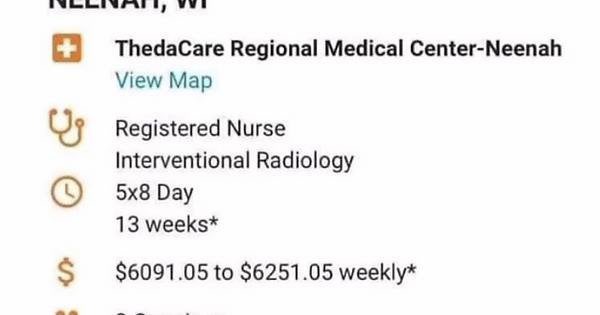
To be fair, I don’t really know what ThedaCare was paying the employees that quit, nor do I know how much they were asking for to stay.

Even without knowing exactly what the anount is, I’d be perfectly happy to bet that amount and more on the guess that what the employees were asking for is less than half, and probably much closer to one third, of what ThedaCare is offering to pay travelers to replace them.

Update on indentured servitude

After Monday’s testimony, Judge McGinnis said ThedaCare did not meet all four of the required prongs to keep the temporary injunction in place.

“Could or should ThedaCare and Ascension get together and work in this transition period? I was hoping so over the weekend and I will continue to hope so. But I’m not able to craft any type of injunction that would require or limit Ascension without, I think, creating more issues or more friction, or taking away the ability that they have to provide healthcare services,” the judge said.

The decision means the seven medical workers can start work immediately at Ascension.

Thank goodness for that. Just knowing the judge thought it was reasonable to do this in the first place is plenty bad, at least he had the sense to realize it and put the whole thing…

The lawsuit itself continues.

Well shit…

This is one of the things I’ve been most worried about

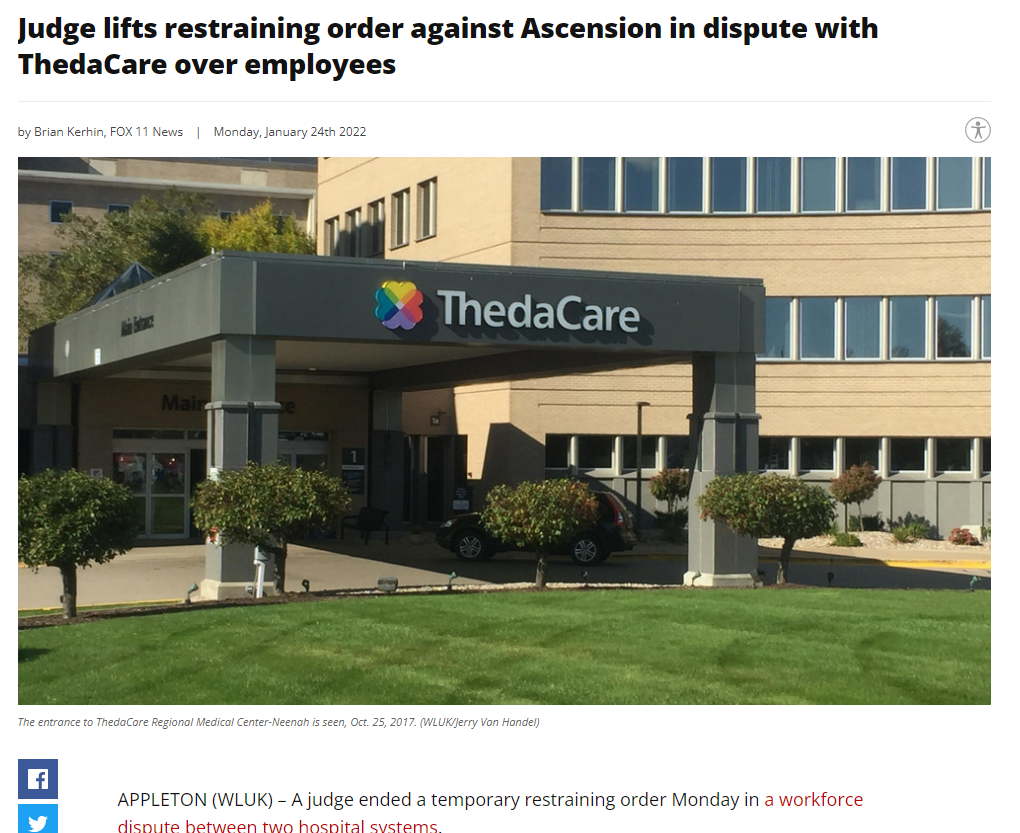
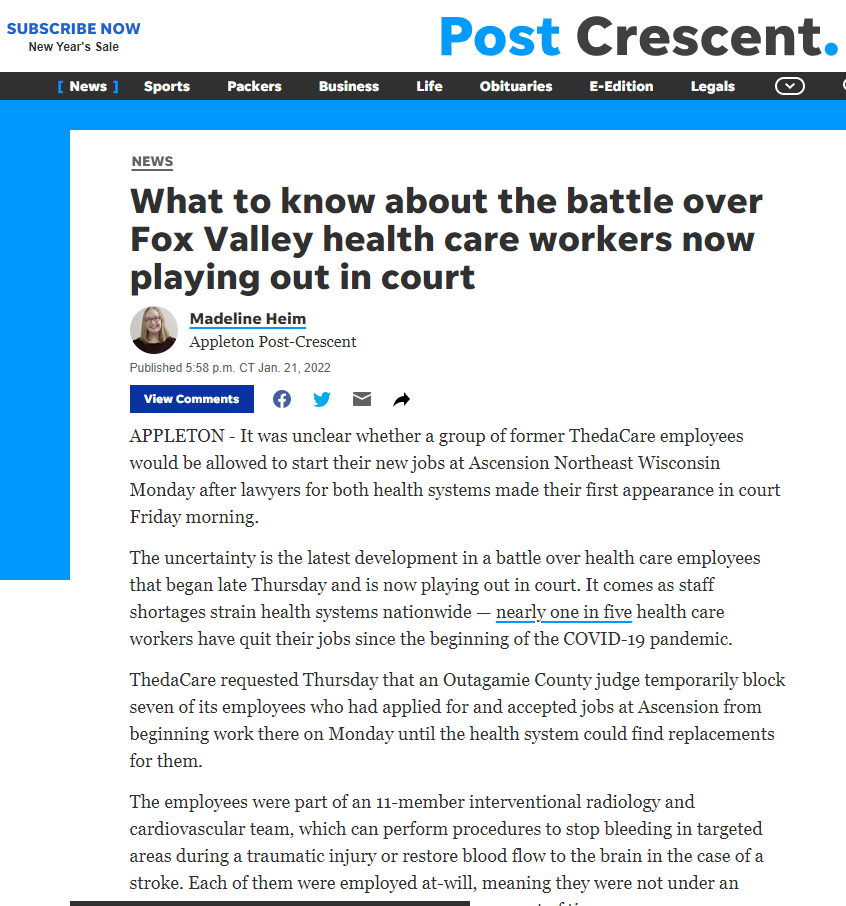
ThedaCare requested Thursday that an Outagamie County [Wisconsin] judge temporarily block seven of its employees who had applied for and accepted jobs at Ascension from beginning work there on Monday until the health system could find replacements for them.

The employees were part of an 11-member interventional radiology and cardiovascular team, which can perform procedures to stop bleeding in targeted areas during a traumatic injury or restore blood flow to the brain in the case of a stroke. Each of them were employed at-will, meaning they were not under an obligation to stay at ThedaCare for a certain amount of time.

Outagamie County Circuit Court Judge Mark McGinnis granted ThedaCare’s request and held an initial hearing Friday morning. The case will get a longer hearing at 10 a.m. Monday.

McGinnis told lawyers for both health systems they should try to work out a temporary agreement by the end of the day Friday about the employees’ status until Monday’s hearing.

Otherwise, he said, the order prohibiting them from going to work at Ascension would be final until a further ruling was made. That means the seven health care workers would not be working at either hospital on Monday.

I intended to write about this when the saga first began because I was concerned, but then I though “Ha! There’s no way a judge in an AT-WILL EMPLOYMENT STATE would tell a bunch of employees they can’t quit their job”, but here we are.

A group of highly specialized hospital employees announced en masse that they were going to leave their current AT-WILL EMPLOYER to go to another facility that paid more. “After approaching ThedaCare with the chance to match the offers they’d been given, [one of the employees] wrote that they were told ‘the long term expense to ThedaCare was not worth the short term cost,’ and no counter-offer would be made”. Instead, the hospital went to court to get an order to prevent the staff from quitting.

And it looks like they’re going to get it.

This is only a preliminary injunction and it doesn’t tell the employees they can’t quit, but it does tell them that they can’t start a new job until the legal matter is settled. There is another hearing on Monday.

Keep in mind that 51% of Americans have 3 months or less worth of savings and 25% have no savings at all. The judge can’t order the employees not to quit but he can (apparently) prevent them from taking another job. I have no doubt the current employer knows, once their employees are prevented from taking another job, all they have to do is drag out the proceedings for a few weeks to a few months and their employees will be faced with the choice of economic ruin or going back to work for them.

It is no secret that hospital staffing is in a major crisis right now and a lot of what is driving that is people taking the opportunity to pursue better paying jobs. The femtosecond this ruling came down, I can guarantee that hospital CEOs all over the country were waking their corporate lawyers up and telling them to get to work filing for injunctions. Why pay competitive wages when you can just get a judge to force your employees to keep working for you? Why pay them at all in fact?

I am a highly specialized, essential worker who is not currently interested in doing the job that I am highly specialized to do.

I imagine people can see why I’m concerned.

Or maybe I don’t?

Bessel Van Der Kolk is a professor of Psychiatry at Boston University School of Medicine and president of the Trauma Research Foundation in Brookline, Massachusetts. He has been studying Trauma and PTSD for decades. His book The Body Keeps the Score was written pre-pandemic but has absolutely exploded in popularity since the whole thing started (I’m trying to wade through it myself right now).

Van Der Kolk was on All Things Considered on NPR this afternoon (his bit starts at around 6:18):

He makes a very compelling argument that, while the pandemic and it’s associated disruptions of every day life are deeply troubling and are, without question, causing an uptick in mental health complaints, those complaints most likely are not exactly “trauma” related. He takes the position that this is an important distinction to make because if you are treating people for pandemic related mental health complaints, and you treat them like they have PTSD or other trauma related issues when they don’t, they may not be receiving the best, most effective treatment for their condition.

I intend to discuss this with my therapist, and the psychiatrist I was referred to by Dr. Rando, but I think Van Der Kolk’s thinking is correct and it is much more likely that what I’m suffering from is garden variety stress and burnout rather than PTSD. I view this as good news because it means that, after my appropriately lengthy time away from work (it will be close to two months by the time I start my new job in February), and the addition of clonidine to my medication regimen, I should be able to get back to work without further issues.

I could be wrong but there is really only one way to find out: wait and see what happens.

I can’t even

“I think it’s hard to process what’s actually happening right now,” said Janet Woodcock, acting commissioner of the Food and Drug Administration, “which is most people are going to get covid.”

Woodcock pitched this as being a necessary acknowledgment when it comes to charting the path forward — recognizing that the focus now needs to be on averting the worst that widespread infections could bring in the near term.

“What we need to do is make sure the hospitals can still function, transportation, you know, other essential services are not disrupted while this happens,” she said. “I think after that will be a good time to reassess how we’re approaching this pandemic.”

Woodcock pitched this as being a necessary acknowledgment when it comes to charting the path forward — recognizing that the focus now needs to be on averting the worst that widespread infections could bring in the near term.

The Washington Post January 11, 2022 at 3:52 p.m. EST

As the Omicron variant spreads like wildfire across the United States, it’s likely just about everybody will be exposed to the strain, but vaccinated people will still fare better, the nation’s leading infectious disease expert said Tuesday.”Omicron, with its extraordinary, unprecedented degree of efficiency of transmissibility, will ultimately find just about everybody,” Dr. Anthony Fauci told J. Stephen Morrison, senior vice president of the Center for Strategic and International Studies. “Those who have been vaccinated … and boosted would get exposed. Some, maybe a lot of them, will get infected

CNN 9:04 AM ET, Wed January 12, 2022

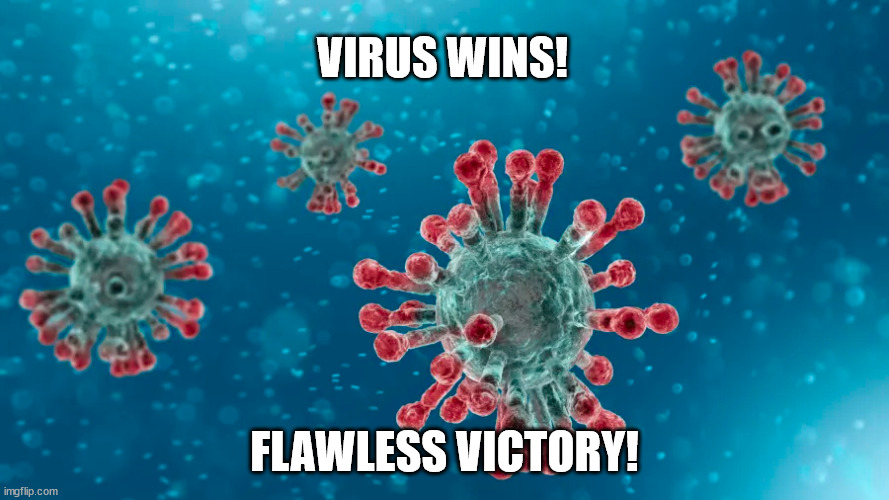
We appear to have surrendered to the virus.

Just as a little thought experiment, imagine if omicron kills 1% of the people it infects (actually it’s higher than that). If, as the experts now seem to think, everyone in the country is going to get infected that’s an additional 3,000,000 plus deaths in the U.S. alone and that’s just from the virus. Add in the number of deaths from delays in receiving care for other non-covid health issues and who knows what kind of numbers we can put up.

Humans have lost, the virus has won, and it was almost entirely avoidable.

Maybe we deserve it.