My very own To Err is Human

In 2000 the Institute of Medicine published To Err is Human: Building a Safer Health System, a landmark work that shone the light, really for the first time, on the incidence and severity of medical errors. Why do I mention this? Because I’m pretty sure I had one.

As seen in the previous post, for the last few weeks I’ve still been having panic attacks and was quite symptomatic with depression and anxiety which prompted Dr. Primary Care to start me on sertraline. While I was seeing Dr. Primary Care I also got a refill on my bupropion since I was nearly out. I started the newly refilled prescription yesterday and noticed something kind of odd.

I want to take a moment here to mention I am aware of the difficulties and pitfalls of identifying pills by sight. Pills from different manufacturers will look different even if they are the same drug and the same dose. That said, I’ve seen quite a few pills in my day and I can generally spot things that are different because of manufacturer and things that are genuinely off.

So I started my newly refilled prescription and noticed that the new pills were markedly larger than the ones I had previously been taking, in spite of appearing to be from the same manufacturer. By chance I have access to examples of 150 mg XL tablets in addition to the 300 mg XL tablets that I am supposed to be taking and I am as certain as I can be without any physical evidence that the pharmacy filled my last prescription for 300 mg XL with 150 mg XL.

Two additional pieces of evidence that could add weight to the theory; once I started taking my new 300 mg XL tablets I immediately started feeling better. My mind has not been this calm in weeks and my overall mood has improved a great deal. Also when I started taking my new 300 mg XL tablets, I was struck with a serious case of insomnia which is a common side effect of bupropion. It hasn’t really been a problem for me1 except for a couple of days after a dose increase.

There are potentially confounding factors to consider however. As mentioned above, I don’t have any physical evidence. All I have is an empty bottle that says 300 mg XL, and a comparison of my mental image of the pills I was taking to known samples of 150mg and 300mg tablets that appear to be, but can’t be said for certain to have, come from the same manufacturer. There is also the addition of sertraline to my regimen. I’ve been on it for a week and, while usually SSRIs take a bit longer to really take full effect, the possibility that I’m just feeling the benefit of the sertraline cannot be ruled out. Finally, the insomnia could very easily have resulted from me working my first full week on night shift after being on a “sleep when you want, wake up when you want” schedule for a couple months.

Pretty sure but not certain.

The thought of the difficulties I’ve been having with my mood over the past few weeks being the result of a medication error is actually reassuring to me. I was feeling distraught because I thought I’d been making all this progress in therapy and introspection and self-analysis and all, but here I was feeling like shit most of the time again. Additionally, if this was a medication error, any doubt about the benefit of being on medication that I may have had is gone. Being on a half-dose was all kinds of no fun so I don’t even want to think what being off it entirely would be like at this point.


1 I know, I know. But there is my baseline insomnia and then extra insomnia gets piled on top of it. Insomniaception. A couple of days after my last increase in dosage I was back to my baseline insomnia.
Back on the SSRI

Those sertraline girls really knock me out1

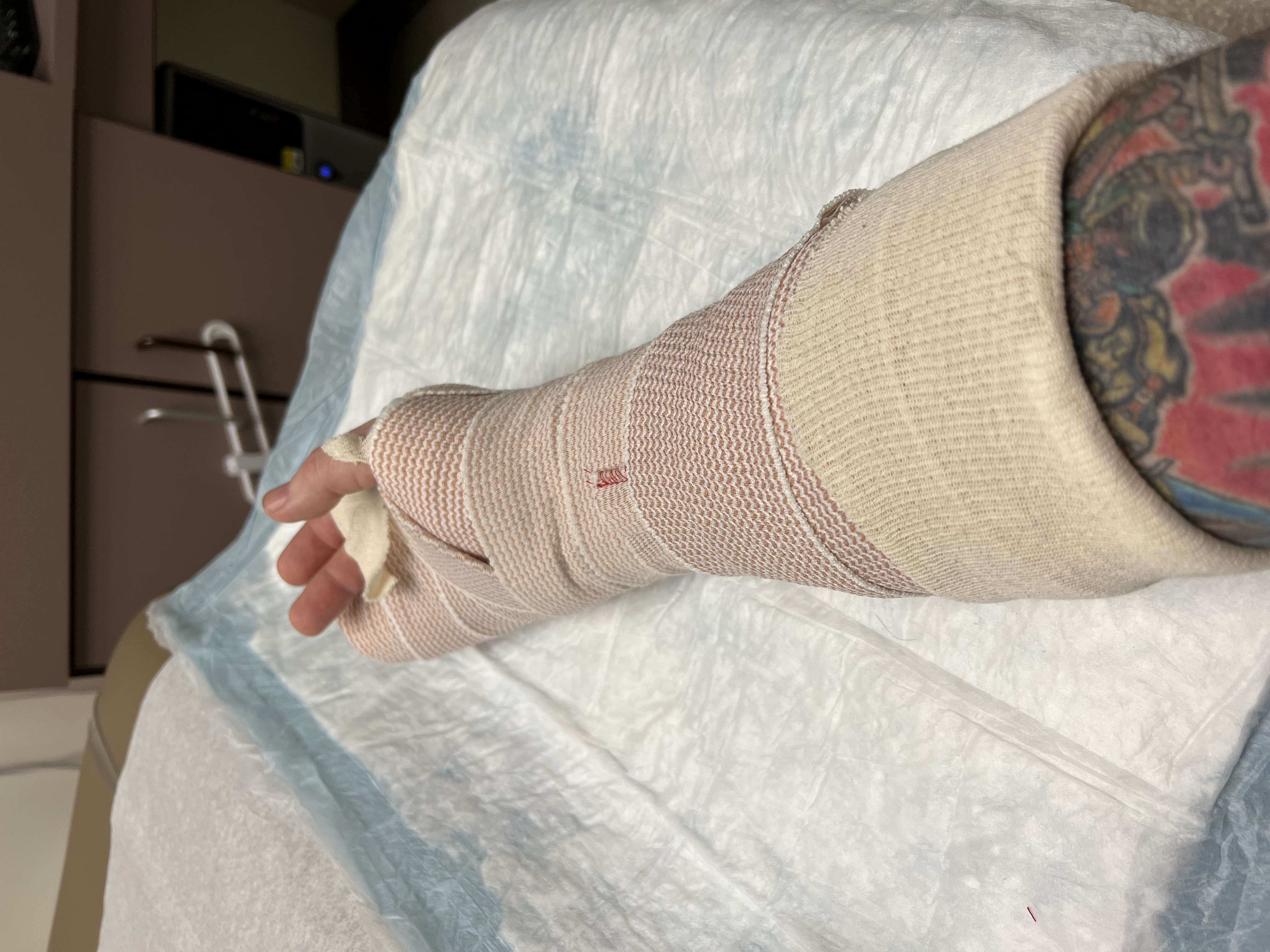
As previously mentioned, I had a cast on my dominant hand for the last few weeks. This condition didn’t make typing or writing impossible but it did make both activities more frustrating than was tolerable for anything less than absolute necessity. Astute readers will doubtless have reached the conclusion that, since this post was typed out by me, and nothing I do here is even in the same neighborhood as anything even remotely necessary, I must be out of the cast now. This is, in fact, the case. Dr. Ortho-Hand was satisfied enough with how the fracture had healed that he didn’t even feel the need to put my in a removable splint. I have an entirely bare naked hand and, in spite of my wrist feeling like it tried to fuse solid and is now only grudgingly moving again, I could not be happier with the situation.

On the topic of not being happier2, astute readers may also have reached the conclusion that, based on the title of this post, my prescribing provider and I have been messing around with the medications again. My PHQ-9 and GAD-7 scores3 have been getting uncomfortably high again and I have still been having panic attacks multiple times per week4. Fortunately my health insurance situation has stabilized and I was able to go back to the primary care provider I had been seeing for several years prior to starting my whirlwind tour of employers. Given the degree to which I have been symptomatic, Dr. Primary Care felt that adding a serotonergic antidepressant would be beneficial. I have been on sertraline twice previously and we’re at 50/50 in terms of it being effective. I did, however, tolerate it well as far as side effects go so that’s where Dr. Primary Care felt we should start5.

One of the complaints I have with antidepressants is they can take a ridiculously long time to really take effect, weeks in some cases, so it may be difficult to tell if any improvement is from the medication or from me just settling back into a work/school routine with a lower baseline stress level.

On the topic of work6, I have started my new, non-patient care job and I feel like it will be okay once my nervous system adjust to the idea of me going to work in a hospital but NOT going to work in an ICU filled with people dying from a pandemic respiratory virus. I’ll talk more about work later (probably) but for now I’m going to go eat some tylenol and rest my wrist.


1 Apologies to Lennon/McCartney

2 How’s that for a transition!

3 Patient Health Questionnaire and Generalized Anxiety Disorder scales for assessing depression and anxiety symptoms. These are a desperate attempt to put an objective measure on the extremely subjective experience of emotional distress. They’ve been validated in peer-reviewed studies and people more knowledgeable on the topic than myself rely on them, so ¯\_(ツ)_/¯

4 I don’t want to leave people with the impression that I’m getting worse. I still think I’m improving in general but “better” is not the same as “well” unfortunately.

5 For those keeping score at home, this brings the total number of prescription psych meds I’m taking to three.

6 I am just killing it with these transitions!

What progress feels like

I spent most of the time between Tuesday morning and Thursday night last week having what felt like one, very long panic attack. Of course I didn’t recognize it as a panic attack until it was over. I seem to have two flavors of panic attack but neither of them have the precise textbook presentation I learned in school; a feeling of impending doom or a fear of death, frequently physical symptom similar to a heart attack, etc. What I seem to get are a sense that everything in the world in general and my life in particular is broken and nothing will ever be able to fix it, or a sense that everyone in my life either hates me or is angry with me about something. The one under discussion was the former and I spammed several friends, family members, and my therapist with texts and emails about how it wasn’t fair how badly my life sucked and now we’re going to have World War III thanks to Putin.

The thing is, at the time I did not feel irrational and, in my defense, it really has been a few pretty rough years and the nature of my reaction wasn’t completely unjustified. The problem started when my (perfectly justified) dissatisfaction with the state of the world turned into an out of control semi barreling downhill with no breaks. On some level I knew something was wrong. I knew I didn’t feel like myself, I couldn’t think clearly. It felt like my brain just wasn’t working right.

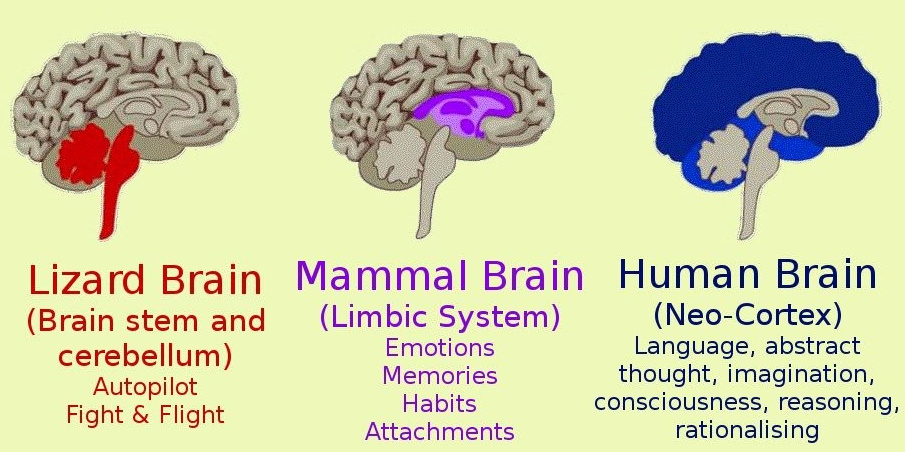
At this point I would like to pause for a moment and talk about brain anatomy. In broad terms, the human brain can be divided into three sections, the brainstem, the limbic system, and the cortex.

what a brain might look like

Generally, the brainstem tells you that you’re hungry and need food, the limbic systems tells you to go find food, and the cortex decides whether you want Thai or Mexican. Or, more importantly, tells you that you can’t go look for food right now because other things are more important.

That inhibitory function of the cortex is the key. The brainstem starts shouting about how there’s a big problem here (whatever it might be, probably a saber-tooth tiger), the limbic system agrees that this is a big problem (whatever it is and we certainly can’t rule out the tiger theory) and we’d better do something about it right fucking now. It is at this point where the cortex is supposed to step in and remind everyone that saber-tooth tigers have been extinct for a really long time now and all that happened was some jerk cut us off in traffic.

Problems start because under enough stress, either intensity or duration, the limbic system kind of stops talking to the cortex. It decides that the big problem (whatever it is) is important enough that we have to deal with it and we don’t have time for the guys at headquarters to get back to us. This effectively removes the filter between thought and action which frequently results in people doing stupid things like spamming their friends with apocalyptic text messages.

Or punching a wall.

What I’m learning is it’s impossible to think yourself out of a panic attack because the thinking part of your brain is quite literally not at the controls anymore. Of course the goal would be to not have panic attacks in the first place which is why I’m also trying very hard to learn the warning signs so I can do something to change the situation before the lunatics take over the asylum as it were. Unfortunately I am really bad at recognizing the warning signs, partly because I’ve spent the overwhelming majority of my life not just ignoring them but desperately pretending they didn’t exist at all. Since nothing my limbic system could do would get the attention of my cortex to have it fix the problem, my limbic system decided it needed to turn things up to a point where they couldn’t be ignored anymore.

The point to all this is I will almost certainly have more panic attacks in the future and people may very well see me behaving somewhat erratically. Be assured that in a matter of hours, or a couple days at most, I’ll be fine so just strap in and hang on.

The benchmark for stupidity

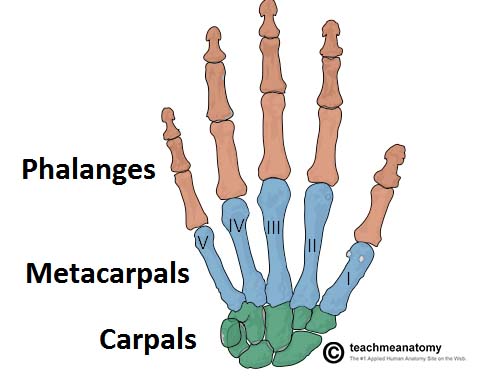
Back in the early 2000s (by which I mean 2000-2001) I worked as a nurse in the emergency department at our local university hospital. Among the injuries we saw on a semi-regular basis were adult men (and it was always men) presenting with a fracture of either the fourth or fifth metacarpal bones (sometimes both) and no other injuries.

what the fourth and fifth metacarpal bones might look like

This particular injury is known as a boxer’s fracture and results from, as one might guess, punching a hard, unyielding surface such as a human skull or, much more frequently, a wall.

In my mind it did not get much dumber than punching a wall. You start off with a bunch of problems, something makes you lose your temper and you punch a wall. Now you have all the same problems you had originally plus a fractured hand (and it was almost always their dominant hand because that’s the one people tend to throw the first punch with) and a bill for an ER visit on top of it.

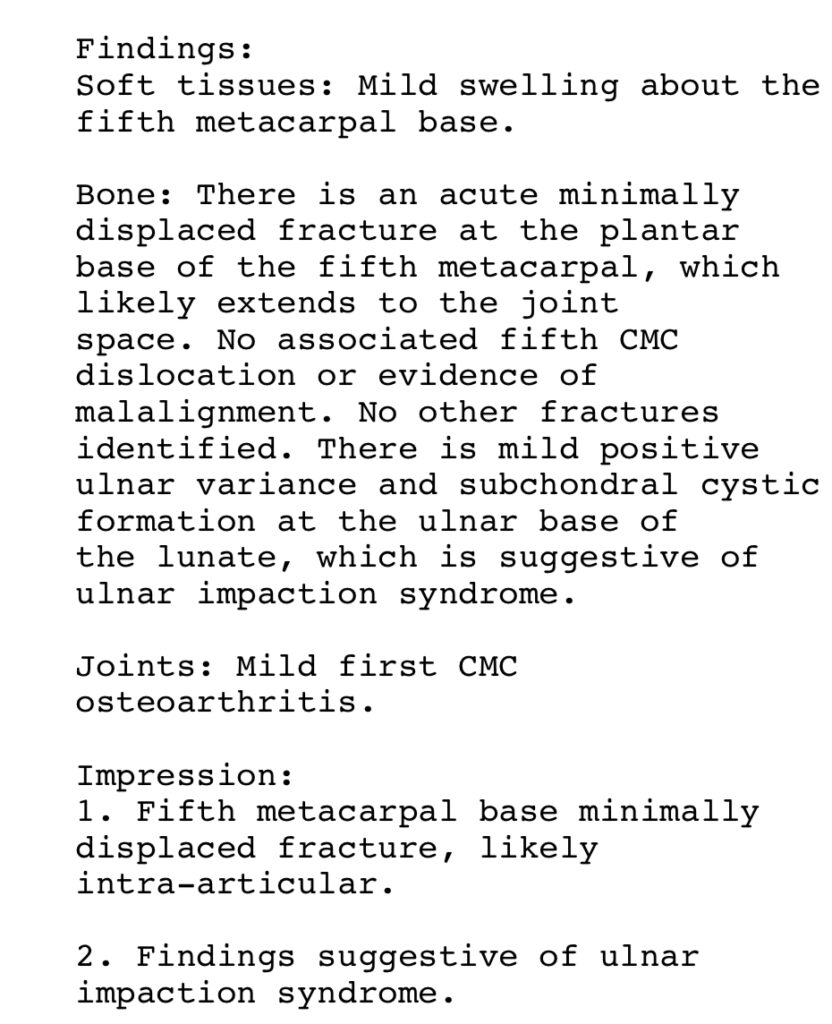
With that all said, this is how I spent my Thursday evening:

ulnar impaction syndrome is a degenerative joint disease similar to arthritis

I knew what I’d done as soon as I did it, although I did spend a couple of hours trying to pretend I didn’t.

So, as the man said, how did it come to this? The short(-ish) answer is that I am having an increasingly difficult time arguing that the PTSD-like symptoms that I’ve been having aren’t actually real1. The longer answer is that I really can’t point to anything specific. I’d been feeling off since the Tuesday of that week; more irritable, harder time concentrating, more than usual sleep disturbances, etc. and by Thursday afternoon I was moderately dysfunctional. I really can’t remember what I was doing right before. I was upstairs actively falling to pieces and went downstairs to try and get somewhere quiet. I went back to my office and then I was back out in the hall with a fractured hand.

I have to revise my opinion of at least some of the boxer’s fractures that came through the ER. This is, I think, a perfect example of that “toxic masculinity” you hear about these days. Men in America, certainly men around my age, were still acculturated into fairly traditional gender roles, especially when it comes to emotional intelligence. There comes a point where the only way one knows how to express and attempt to manage the intensity of emotions that one is experiencing is through violent rage because men have traditionally been actively discouraged from experiencing negative emotions in any other way.

I hope that others can maybe avoid these self-destructive patterns and learn a lesson from my experience.

And that lesson is: punch something softer than a wall.


1 This is not to say that my brain isn’t trying to tell me this is just an example of how serious I am about sloth and malingering; that I would go so far as to injure myself just so I could better fake mental health issues shows real dedication

This will definitely make me a better nurse

Probably a better teacher too when it comes to that. This is the kind of insightful critiques that really help me to build the skills I’m going to require to be successful.

I suppose I should clarify; I had a paper returned for revision and among the reasons it was kicked back are:

Missing sentence case for article title – The titles of work appear in title case, with most words capitalized, instead of sentence case. 

Missing italics of journal title – APA style requires the use of italicized font for periodical volumes. 

Separate the single author and the publication date with a comma in-text. 

The abbreviated version of the word ‘volume’ is improperly included. 

All text should be double-spaced

Some rando evaluator

What I’d really like to get from an evaluation is maybe some indication of whether or not I understood the material from the class well enough to put together a coherent argument. What I get is ”MISSING COMMAS, IMPROPER ABBREVIATION FOR ’VOLUME’!”

Which would make sense if I was working on my masters in copy editing.

But I’m not.

Who could have predicted?

To be fair, I don’t really know what ThedaCare was paying the employees that quit, nor do I know how much they were asking for to stay.

Even without knowing exactly what the anount is, I’d be perfectly happy to bet that amount and more on the guess that what the employees were asking for is less than half, and probably much closer to one third, of what ThedaCare is offering to pay travelers to replace them.

Update on indentured servitude

After Monday’s testimony, Judge McGinnis said ThedaCare did not meet all four of the required prongs to keep the temporary injunction in place.

“Could or should ThedaCare and Ascension get together and work in this transition period? I was hoping so over the weekend and I will continue to hope so. But I’m not able to craft any type of injunction that would require or limit Ascension without, I think, creating more issues or more friction, or taking away the ability that they have to provide healthcare services,” the judge said.

The decision means the seven medical workers can start work immediately at Ascension.

Thank goodness for that. Just knowing the judge thought it was reasonable to do this in the first place is plenty bad, at least he had the sense to realize it and put the whole thing…

The lawsuit itself continues.

Well shit…

This is one of the things I’ve been most worried about

ThedaCare requested Thursday that an Outagamie County [Wisconsin] judge temporarily block seven of its employees who had applied for and accepted jobs at Ascension from beginning work there on Monday until the health system could find replacements for them.

The employees were part of an 11-member interventional radiology and cardiovascular team, which can perform procedures to stop bleeding in targeted areas during a traumatic injury or restore blood flow to the brain in the case of a stroke. Each of them were employed at-will, meaning they were not under an obligation to stay at ThedaCare for a certain amount of time.

Outagamie County Circuit Court Judge Mark McGinnis granted ThedaCare’s request and held an initial hearing Friday morning. The case will get a longer hearing at 10 a.m. Monday.

McGinnis told lawyers for both health systems they should try to work out a temporary agreement by the end of the day Friday about the employees’ status until Monday’s hearing.

Otherwise, he said, the order prohibiting them from going to work at Ascension would be final until a further ruling was made. That means the seven health care workers would not be working at either hospital on Monday.

I intended to write about this when the saga first began because I was concerned, but then I though “Ha! There’s no way a judge in an AT-WILL EMPLOYMENT STATE would tell a bunch of employees they can’t quit their job”, but here we are.

A group of highly specialized hospital employees announced en masse that they were going to leave their current AT-WILL EMPLOYER to go to another facility that paid more. “After approaching ThedaCare with the chance to match the offers they’d been given, [one of the employees] wrote that they were told ‘the long term expense to ThedaCare was not worth the short term cost,’ and no counter-offer would be made”. Instead, the hospital went to court to get an order to prevent the staff from quitting.

And it looks like they’re going to get it.

This is only a preliminary injunction and it doesn’t tell the employees they can’t quit, but it does tell them that they can’t start a new job until the legal matter is settled. There is another hearing on Monday.

Keep in mind that 51% of Americans have 3 months or less worth of savings and 25% have no savings at all. The judge can’t order the employees not to quit but he can (apparently) prevent them from taking another job. I have no doubt the current employer knows, once their employees are prevented from taking another job, all they have to do is drag out the proceedings for a few weeks to a few months and their employees will be faced with the choice of economic ruin or going back to work for them.

It is no secret that hospital staffing is in a major crisis right now and a lot of what is driving that is people taking the opportunity to pursue better paying jobs. The femtosecond this ruling came down, I can guarantee that hospital CEOs all over the country were waking their corporate lawyers up and telling them to get to work filing for injunctions. Why pay competitive wages when you can just get a judge to force your employees to keep working for you? Why pay them at all in fact?

I am a highly specialized, essential worker who is not currently interested in doing the job that I am highly specialized to do.

I imagine people can see why I’m concerned.

Or maybe I don’t?

Bessel Van Der Kolk is a professor of Psychiatry at Boston University School of Medicine and president of the Trauma Research Foundation in Brookline, Massachusetts. He has been studying Trauma and PTSD for decades. His book The Body Keeps the Score was written pre-pandemic but has absolutely exploded in popularity since the whole thing started (I’m trying to wade through it myself right now).

Van Der Kolk was on All Things Considered on NPR this afternoon (his bit starts at around 6:18):

He makes a very compelling argument that, while the pandemic and it’s associated disruptions of every day life are deeply troubling and are, without question, causing an uptick in mental health complaints, those complaints most likely are not exactly “trauma” related. He takes the position that this is an important distinction to make because if you are treating people for pandemic related mental health complaints, and you treat them like they have PTSD or other trauma related issues when they don’t, they may not be receiving the best, most effective treatment for their condition.

I intend to discuss this with my therapist, and the psychiatrist I was referred to by Dr. Rando, but I think Van Der Kolk’s thinking is correct and it is much more likely that what I’m suffering from is garden variety stress and burnout rather than PTSD. I view this as good news because it means that, after my appropriately lengthy time away from work (it will be close to two months by the time I start my new job in February), and the addition of clonidine to my medication regimen, I should be able to get back to work without further issues.

I could be wrong but there is really only one way to find out: wait and see what happens.

In praise of 2-(2,6-dichlorophenylamino)-2-imidazoline hydrochloride

More commonly known as clonidine. Clonidine is an alpha-adrenergic agonist, and should not be confused with clonazepam (Klonopin) which is a benzodiazepine. As was previously mentioned, I had an appointment with Dr. Rando and among the things she recommended was adding a medication for anxiety to the antidepressant I’m already taking. Discussed options included benzodiazepines (which are not recommended for use in PTSD1), beta-blockers (which she was hesitant to put me on since I had been having issues with fatigue), prazosin (which is also an alpha blocker but is only indicated to treat nightmares associated with PTSD2), and clonidine.

TL; DR – I started on clonidine and I feel like it’s working really well. My baseline level of nervous system jangling has dropped noticeably. You are now safe to skip the rest of this post which consists of some rambling about how clonidine works, why I was positively enthusiastic to try it, and how irrational the distinction I have in my head between “psychiatric” medications and “physical” medications is.

My reaction to the suggestion of more medication highlights again my physical medicine bias. I resisted being on an antidepressant for a long time, and even after I started one initially my goal was to get off it as soon as possible (and then resisted going back on one when it looked like it was going to be required). However, when Dr. Rando suggested clonidine I was positively enthusiastic for a couple of different reasons. First, I am well familiar with clonidine. It was a mainstay medication for our ECMO program because it (at least theoretically) has beneficial effects on pain control, sedation, and blood pressure, it is available as a pill that can easily be crushed, dissolved, and put down a feeding tube if the patient can’t swallow, and, perhaps most importantly to the Powers-That-Be, it is dirt cheap. I understand how it works and, because I know how it works, I could see how it would help with the difficulties I have been having. The other reason I was enthusiastic to try it was the opportunity to see first hand if it really did work the way it was supposed to.

I want to talk a bit about exactly how irrational it is that I would resist adding, say, an SSRI to treat PTSD while not only accepting but being enthusiastic about trying clonidine. As I mentioned above, clonidine is an alpha-adrenergic agonist, which means that it inhibits some of the fight-flight-or-freeze response that our nervous system does when it feels threatened. In past times this response was a great adaptation because it allowed our progenitors to run away from saber-toothed tigers. In modern times it can be maladaptive because modern life is very good at creating stress that one can’t fight or run away from so the stimulation of our nervous system doesn’t turn off. Ever. The practical effect of using an alpha-blocker to moderate the activation of our nervous system is to reduce the hyper-alert state, resulting in improvement in tension and anxiety. Clonidine can do this by having the ability to cross the blood-brain barrier3 and by being structurally similar to norepinephrine, one of the main neurotransmitters in our nervous system. In terms of it’s mechanism of action, it is essentially indistinguishable from most medications that have primarily psychiatric indications.

Of course none of that matters to my brain. It’s a medication that I have used and am familiar with, and it has primarily physical indications which means it’s a real medication and not one of those woo-woo brain drugs (that work in extremely similar ways to achieve similar effects). Totally irrational.

This is one occasion on which I will not complain about my brain behaving irrationally. Whatever the reason I was able to persuade my brain that this was a necessity, I’m very pleased with how the medication is working so far. It has settled my nervous system sufficiently to make every day life a great deal less challenging.

There is more to catch up on but I am taking advantage of the reduction in mental clutter to enjoy doing things. What kind of things? Almost anything really. Even doing chores around the house is less troublesome when you aren’t spending an excessive amount of energy trying to keep from having a complete breakdown.


1 I’m not entirely sure why benzodiazepines aren’t indicated for PTSD. I suspect it has something to do with benzos having the potential to be disassociative which, based on my extremely limited understanding, is probably counterproductive.

2 I have no idea why one alpha blocker (prazosin) is only indicated to treat nightmares and another alpha blocker (clonidine) is indicated for general symptom treatment. Seriously, no clue.

3 I also don’t know enough about the blood-brain barrier to even attempt to explain it, so here’s Wikipedia.