This is one of the things I’ve been most worried about

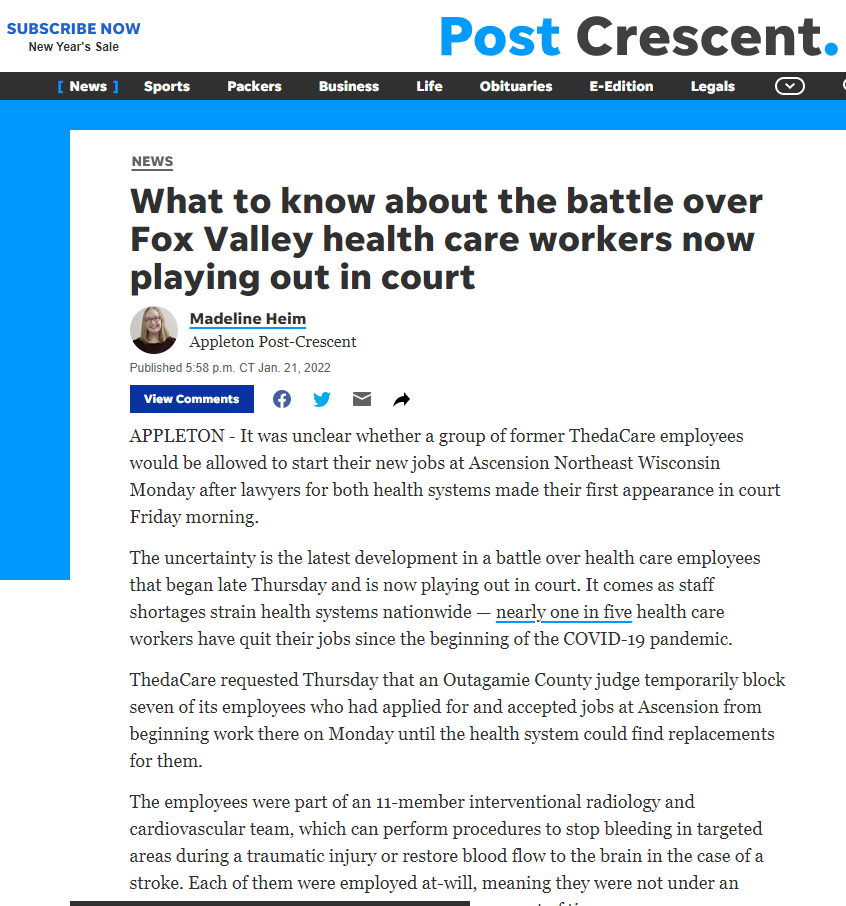
ThedaCare requested Thursday that an Outagamie County [Wisconsin] judge temporarily block seven of its employees who had applied for and accepted jobs at Ascension from beginning work there on Monday until the health system could find replacements for them.

The employees were part of an 11-member interventional radiology and cardiovascular team, which can perform procedures to stop bleeding in targeted areas during a traumatic injury or restore blood flow to the brain in the case of a stroke. Each of them were employed at-will, meaning they were not under an obligation to stay at ThedaCare for a certain amount of time.

Outagamie County Circuit Court Judge Mark McGinnis granted ThedaCare’s request and held an initial hearing Friday morning. The case will get a longer hearing at 10 a.m. Monday.

McGinnis told lawyers for both health systems they should try to work out a temporary agreement by the end of the day Friday about the employees’ status until Monday’s hearing.

Otherwise, he said, the order prohibiting them from going to work at Ascension would be final until a further ruling was made. That means the seven health care workers would not be working at either hospital on Monday.

I intended to write about this when the saga first began because I was concerned, but then I though “Ha! There’s no way a judge in an AT-WILL EMPLOYMENT STATE would tell a bunch of employees they can’t quit their job”, but here we are.

A group of highly specialized hospital employees announced en masse that they were going to leave their current AT-WILL EMPLOYER to go to another facility that paid more. “After approaching ThedaCare with the chance to match the offers they’d been given, [one of the employees] wrote that they were told ‘the long term expense to ThedaCare was not worth the short term cost,’ and no counter-offer would be made”. Instead, the hospital went to court to get an order to prevent the staff from quitting.

And it looks like they’re going to get it.

This is only a preliminary injunction and it doesn’t tell the employees they can’t quit, but it does tell them that they can’t start a new job until the legal matter is settled. There is another hearing on Monday.

Keep in mind that 51% of Americans have 3 months or less worth of savings and 25% have no savings at all. The judge can’t order the employees not to quit but he can (apparently) prevent them from taking another job. I have no doubt the current employer knows, once their employees are prevented from taking another job, all they have to do is drag out the proceedings for a few weeks to a few months and their employees will be faced with the choice of economic ruin or going back to work for them.

It is no secret that hospital staffing is in a major crisis right now and a lot of what is driving that is people taking the opportunity to pursue better paying jobs. The femtosecond this ruling came down, I can guarantee that hospital CEOs all over the country were waking their corporate lawyers up and telling them to get to work filing for injunctions. Why pay competitive wages when you can just get a judge to force your employees to keep working for you? Why pay them at all in fact?

I am a highly specialized, essential worker who is not currently interested in doing the job that I am highly specialized to do.

I imagine people can see why I’m concerned.
Or maybe I don’t?

Bessel Van Der Kolk is a professor of Psychiatry at Boston University School of Medicine and president of the Trauma Research Foundation in Brookline, Massachusetts. He has been studying Trauma and PTSD for decades. His book The Body Keeps the Score was written pre-pandemic but has absolutely exploded in popularity since the whole thing started (I’m trying to wade through it myself right now).

Van Der Kolk was on All Things Considered on NPR this afternoon (his bit starts at around 6:18):

He makes a very compelling argument that, while the pandemic and it’s associated disruptions of every day life are deeply troubling and are, without question, causing an uptick in mental health complaints, those complaints most likely are not exactly “trauma” related. He takes the position that this is an important distinction to make because if you are treating people for pandemic related mental health complaints, and you treat them like they have PTSD or other trauma related issues when they don’t, they may not be receiving the best, most effective treatment for their condition.

I intend to discuss this with my therapist, and the psychiatrist I was referred to by Dr. Rando, but I think Van Der Kolk’s thinking is correct and it is much more likely that what I’m suffering from is garden variety stress and burnout rather than PTSD. I view this as good news because it means that, after my appropriately lengthy time away from work (it will be close to two months by the time I start my new job in February), and the addition of clonidine to my medication regimen, I should be able to get back to work without further issues.

I could be wrong but there is really only one way to find out: wait and see what happens.

In praise of 2-(2,6-dichlorophenylamino)-2-imidazoline hydrochloride

More commonly known as clonidine. Clonidine is an alpha-adrenergic agonist, and should not be confused with clonazepam (Klonopin) which is a benzodiazepine. As was previously mentioned, I had an appointment with Dr. Rando and among the things she recommended was adding a medication for anxiety to the antidepressant I’m already taking. Discussed options included benzodiazepines (which are not recommended for use in PTSD1), beta-blockers (which she was hesitant to put me on since I had been having issues with fatigue), prazosin (which is also an alpha blocker but is only indicated to treat nightmares associated with PTSD2), and clonidine.

TL; DR – I started on clonidine and I feel like it’s working really well. My baseline level of nervous system jangling has dropped noticeably. You are now safe to skip the rest of this post which consists of some rambling about how clonidine works, why I was positively enthusiastic to try it, and how irrational the distinction I have in my head between “psychiatric” medications and “physical” medications is.

My reaction to the suggestion of more medication highlights again my physical medicine bias. I resisted being on an antidepressant for a long time, and even after I started one initially my goal was to get off it as soon as possible (and then resisted going back on one when it looked like it was going to be required). However, when Dr. Rando suggested clonidine I was positively enthusiastic for a couple of different reasons. First, I am well familiar with clonidine. It was a mainstay medication for our ECMO program because it (at least theoretically) has beneficial effects on pain control, sedation, and blood pressure, it is available as a pill that can easily be crushed, dissolved, and put down a feeding tube if the patient can’t swallow, and, perhaps most importantly to the Powers-That-Be, it is dirt cheap. I understand how it works and, because I know how it works, I could see how it would help with the difficulties I have been having. The other reason I was enthusiastic to try it was the opportunity to see first hand if it really did work the way it was supposed to.

I want to talk a bit about exactly how irrational it is that I would resist adding, say, an SSRI to treat PTSD while not only accepting but being enthusiastic about trying clonidine. As I mentioned above, clonidine is an alpha-adrenergic agonist, which means that it inhibits some of the fight-flight-or-freeze response that our nervous system does when it feels threatened. In past times this response was a great adaptation because it allowed our progenitors to run away from saber-toothed tigers. In modern times it can be maladaptive because modern life is very good at creating stress that one can’t fight or run away from so the stimulation of our nervous system doesn’t turn off. Ever. The practical effect of using an alpha-blocker to moderate the activation of our nervous system is to reduce the hyper-alert state, resulting in improvement in tension and anxiety. Clonidine can do this by having the ability to cross the blood-brain barrier3 and by being structurally similar to norepinephrine, one of the main neurotransmitters in our nervous system. In terms of it’s mechanism of action, it is essentially indistinguishable from most medications that have primarily psychiatric indications.

Of course none of that matters to my brain. It’s a medication that I have used and am familiar with, and it has primarily physical indications which means it’s a real medication and not one of those woo-woo brain drugs (that work in extremely similar ways to achieve similar effects). Totally irrational.

This is one occasion on which I will not complain about my brain behaving irrationally. Whatever the reason I was able to persuade my brain that this was a necessity, I’m very pleased with how the medication is working so far. It has settled my nervous system sufficiently to make every day life a great deal less challenging.

There is more to catch up on but I am taking advantage of the reduction in mental clutter to enjoy doing things. What kind of things? Almost anything really. Even doing chores around the house is less troublesome when you aren’t spending an excessive amount of energy trying to keep from having a complete breakdown.


1 I’m not entirely sure why benzodiazepines aren’t indicated for PTSD. I suspect it has something to do with benzos having the potential to be disassociative which, based on my extremely limited understanding, is probably counterproductive.

2 I have no idea why one alpha blocker (prazosin) is only indicated to treat nightmares and another alpha blocker (clonidine) is indicated for general symptom treatment. Seriously, no clue.

3 I also don’t know enough about the blood-brain barrier to even attempt to explain it, so here’s Wikipedia.

Yeah, so I have PTSD

And generalized anxiety disorder as well, just for good measure (F43. 12 and F41. 1 for those tracking ICD-10 codes). I’ve probably had PTSD for a while now just based on the most common reaction I’ve had when I tell people this, which has been some variation of “Wait… you didn’t know?”

One of the funny1 thing about how my brain works is how it managed to have virtually every symptom of PTSD but somehow rationalize each and every one of them as being not only unrelated to PTSD, but as being completely separate issues that are unrelated to each other. Haven’t been sleeping well? I never sleep well. Been really irritable? Totally understandable, I’ve been busy and under a lot of pressure. Hyper-alert and anxious? I’ve been an ICU nurse for 20 years, being alert is part of the job and I’m just having trouble turning it off. Haven’t been able to make it through a whole shift at work because of overwhelming angst? Fatigue from cancer treatment combined with baseline laziness.

There were a few incidents which really made me think there was something more going on and my increasing dysfunction at work (documented in other posts on this site) was becoming unsustainable. I talked to my therapist, I talked to my primary care provider (actually I talked to Dr. Rando, MD because my regular PCP was booked out until the end of the month) and I got a referral to a psychiatrist. I’m off work until the middle of next month and when I go back to work I will not be returning to bedside nursing. As of the third week of February I will be a nursing supervisor at Swedish.

I’ll probably talk more about this new job later. I have a month to, as my father says, get my nervous system pulled back inside my body and then we get to find out if I can keep working as a nurse in any capacity or if I really have managed to blow out all my circuits.


1 Not like “ha ha” funny, more like “what’s that smell” funny.

I can’t even

“I think it’s hard to process what’s actually happening right now,” said Janet Woodcock, acting commissioner of the Food and Drug Administration, “which is most people are going to get covid.”

Woodcock pitched this as being a necessary acknowledgment when it comes to charting the path forward — recognizing that the focus now needs to be on averting the worst that widespread infections could bring in the near term.

“What we need to do is make sure the hospitals can still function, transportation, you know, other essential services are not disrupted while this happens,” she said. “I think after that will be a good time to reassess how we’re approaching this pandemic.”

Woodcock pitched this as being a necessary acknowledgment when it comes to charting the path forward — recognizing that the focus now needs to be on averting the worst that widespread infections could bring in the near term.

The Washington Post January 11, 2022 at 3:52 p.m. EST

As the Omicron variant spreads like wildfire across the United States, it’s likely just about everybody will be exposed to the strain, but vaccinated people will still fare better, the nation’s leading infectious disease expert said Tuesday.”Omicron, with its extraordinary, unprecedented degree of efficiency of transmissibility, will ultimately find just about everybody,” Dr. Anthony Fauci told J. Stephen Morrison, senior vice president of the Center for Strategic and International Studies. “Those who have been vaccinated … and boosted would get exposed. Some, maybe a lot of them, will get infected

CNN 9:04 AM ET, Wed January 12, 2022

We appear to have surrendered to the virus.

Just as a little thought experiment, imagine if omicron kills 1% of the people it infects (actually it’s higher than that). If, as the experts now seem to think, everyone in the country is going to get infected that’s an additional 3,000,000 plus deaths in the U.S. alone and that’s just from the virus. Add in the number of deaths from delays in receiving care for other non-covid health issues and who knows what kind of numbers we can put up.

Humans have lost, the virus has won, and it was almost entirely avoidable.

Maybe we deserve it.

Fair warning

Those among the none people visiting this site who do so exclusively for all the cancer talk may be in for a bit of disappointment in the next weeks to months. Cancer is still a thing, I will still be getting treatments, and I will still be writing about them here but what is top of mind right now, as odd as it seems, is not cancer. If me droning on about mental and emotional health is not of interest, you may want to check back later.

I have a blind spot when it comes to mental health1. This has come up before but I want to highlight one manifestation of this blind spot in particular. I touched on the thought process that my brain went through regarding my ability (or inability) to work briefly in a previous post and the same pattern applies more generally as well. In order to explain the behaviors I see in myself while avoiding the conclusion that those behaviors are the result of mental health factors I may not have complete control over requires some quite startling twists of logic, and accepting, without question, the assumptions necessary to make those twists is, I think, a large part of the problem.

What the fuck am I talking about? Let me offer an example;

I’ve been irritable recently1. Things of little to no consequence have been getting under my skin to an exceedingly disproportionate degree. I like to think I’m a rational person who doesn’t let emotion influence my decision making. Let’s run through the thought process I used to make all of those things be true and a little bit of the consequences of the necessary assumptions:

  • I am a rational person
  • I am getting irritated over trivial things, which isn’t rational
  • I must be consciously choosing to get irritated because I don’t let emotion influence what I do
  • Wait, isn’t choosing to be irritated even more irrational? There must be a reason I’m doing this
  • I must be trying to manipulate people in to thinking I’m getting irritated so they’ll think the pressure and stress are getting to me and I’ll have an excuse to not work
  • Why do I need an excuse to not work? I like my job, I enjoy being a nurse, and since I’m immune to the physical and mental consequences of stress, it must just be that I’m lazy and don’t want to work
  • Wow. So I’m feigning mental illness just to get out of work? I must be a really terrible person. I really need to stop doing that
  • I’ve tried but I can’t seem to stop pretending I’m disproportionately irritable, therefore I am both lazier and more of a terrible person than I even realized.

For comparison, the process I’ve been working with more recently is as follows:

  • I haven’t been able to stop being a terrible person and drop the pretense that I have some sort of incipient mental health issue because I actually have an incipient mental health issue and all the things I’ve been “pretending” to do are actual symptoms
  • Also, it isn’t so much “incipient” as it is “fully armed and operational”

Upon reflection, what this reminds me of most is a well known headline from The Onion:

Or in my case, why can’t I stop pretending to have PTSD?

Anyway, excluding any other analysis, Occam’s Razor would lead one to suspect that the latter chain of reasoning was correct over the former, and it also has the benefit of not requiring me to be a totally shit human being in order to be true.

Which is, of course, why my brain keeps telling me it can’t possibly be true. It seems I’m just trying to let myself off the hook and rationalize my ongoing terrible behavior. After all, if I believe it’s a genuine mental health issue I won’t have to give it up, stop being a lazy-ass, and go back to work. My brain, as has been mentioned, is not terribly helpful sometimes.

If one accepts the unlikely premise that spending the last two years working in an ICU during the worst pandemic in a century may have had an impact on my mental health, comfort can be taken in the knowledge that I am far from alone. Caillet et al. (2020)2 found the incidence of anxiety and depression among ICU caregivers were 48% and 16%, respectively, and PTSD symptoms were present in 27% of respondents. That was as of September and I suspect those numbers have not improved3.

I can’t say how this is all going to play out in the larger context but brought down to the level of one individual (if that individual happens to be me) I can make what I think are some very accurate short-term predictions.

But that is a story for another day.


1 This is the equivalent of saying the Pacific Ocean gets quite deep in some bits.

2 Caillet, A., Coste, C., Sanchez, R., & Allaouchiche, B. (2020). Psychological Impact of COVID-19 on ICU Caregivers. Anaesthesia, critical care & pain medicine, 39(6), 717–722. https://doi.org/10.1016/j.accpm.2020.08.006

This in-line citation is really problematic. What kind of maniac has both in-line citations and endnotes? This is exactly the kind of societal collapse I’ve been warning about. My only excuse is that my school uses APA format (in-line citations) and virtually all the journals and whatnot I read use AMA (endnotes). That said, no excuse can justify this. I’m a monster.

3 The only reason I’m even a little uncertain about the current rates of depression, anxiety, and PTSD being worse or better is I can’t exclude the possibility that all the people predisposed to those conditions have already washed out which would make the percentages look better in spite of the overall situation being worse.

I feel like I should put this here

I stumbled across this kind of randomly while wandering around the internets and, for a couple different reasons, thought I should share it.

As mentioned previously, I’ve had the pandemic right up in my face pretty much since the beginning. I’ve watched it spread, wax, wane, wax again and, most significantly I think, I’ve dealt with essentially nothing else in my professional life. My therapist pointed out to me recently that when you’re that close to something, it tends to look very large. Sometimes disproportionately so.

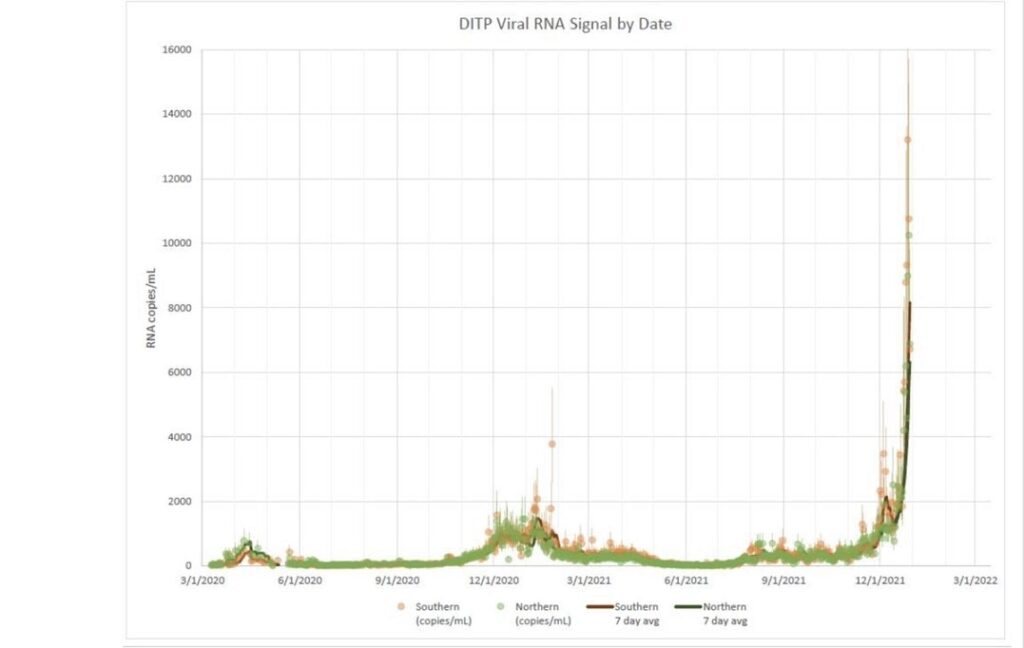
I am by no means downplaying what’s going on. We’re still really not in a good place when in comes to case numbers, rate of spread, and available hospital resources. Models are predicting that the omicron surge will peak in 2-3 weeks with close to 1,000,000 new cases per day in the United States. Keep in mind, too, that the official counts are still, very likely, drastically undercounting. This graph is wastewater analysis from Boston showing the increase in viral DNA in sewage. The spike from omicron completely obliterates the spikes from all the other surges we’ve seen so far suggesting that there are likely significantly more cases than have been recognized;

All that said, we have come a long way from the beginning and there is still hope that we can survive this with something that looks more or less like modern society relatively intact.

Now we come to what brought me here today;

“Your Local Epidemiologist (YLE)” is written by Dr. Katelyn Jetelina, MPH PhD—an epidemiologist, biostatistician, professor, researcher, wife, and mom of two little girls. During the day she has a research lab and teaches graduate-level courses, but at night she writes this newsletter. Her main goal is to “translate” the ever-evolving public health science so that people will be well equipped to make evidence-based decisions, rather than decisions based in fear. 

The most recent newsletter is entitled “There is good news” and is worth a read. Things are bad but they could be worse and they will get better. Eventually.

Anyway, read it and feel some momentary relief from the doom that I’ve been spouting.

https://yourlocalepidemiologist.substack.com/p/there-is-good-news

Another day, another surge

As has been noted previously, I have been putting in some hours doing contact tracing with employee health. This has been good in that it has given something to do that I can get paid for while I’m not at peak performance. This has been bad because it is a naked, unblinking look at the waxing and waning of the pandemic.

Over the last two days I was covering the afternoons on the covid symptom line, responding to people who have left voicemails reporting exposures or to get set up for testing when they have symptoms. I started at 4pm yesterday and found that there were “more than twenty messages”, according to the unjustifiably cheerful automated voice on the voicemail box. I spent four hours responding to messages, cleared 15 or 20 of them, and when I was done there were still “more than twenty messages” and I hadn’t gotten past messages left at 10:00 that morning. I did another four hours today, cleared another 10-15 messages, still had “more than twenty messages” in the queue and didn’t get past messages left at 11:30 yesterday morning.

The good news is that all the people I talked to that were positive for covid were vaccinated nd not terribly sick. The bad news is that there were maybe two or three that said they had been exposed at work and all the rest had a story that was some variation of “I got together with my family over Christmas and my [aunt/uncle/cousin/sister/brother/whatever] tested positive [the next day/a couple days later] and now I’m feeling sick”.

STAY THE FUCK HOME!