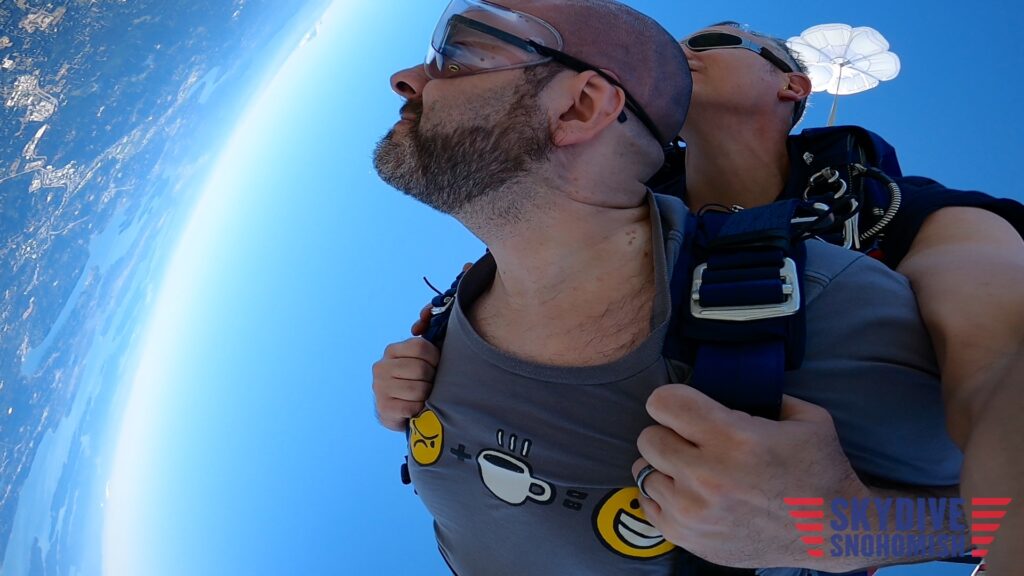
I’ve done this twice now and, again, cannot recommend it highly enough. There is no way to adequately convey what it’s like. Which is why I’m going to half-ass trying to explain exactly that.
Your cerebral cortex, what us medical professionals refer to as “the wrinkly part of your brain” understands parachutes, at least on a general level. Not in any exact detail necessarily but in broad strokes. It also has at least some impression of their record for safety and reliability. It understands that humans are tool-using animals and that we can greatly extend our capabilities through technology.
Your cerebellum, known to medical professionals as “the lumpy bit near the base of the skull”, doesn’t understand any of that. The cerebellum hasn’t had a major update to its operating system in probably 100,000 years. The cerebellum is mostly in charge of your autonomic nervous system, the part of your nervous system that controls things like the fight-or-flight response. It’s still on the lookout for sabre-tooth tigers and hasn’t really figured out any other way to see the world.
So there you are up in an airplane, which is kind of throwing the cerebellum off a little already, and then you’re going to do something that, as far as your cerebellum is concerned, will be absolutely, 100% assured fatal. This tends to cause a certain amount of unease.
Then, of course, the parachute opens and you float safely back down to earth.
Now remember, as far as your cerebellum was concerned, ten minutes ago you did something that should have, without any doubt or question, caused your demise. It was as certain as night following day that you were going to die. No avoiding it, no other possible outcome.
And then you don’t die. And not only that, you’re not even hurt!
Just imagine how confused that must make your cerebellum. Here is this thing that hasn’t learned much of anything new for the last 100 centuries and something just happened that it has absolutely no way of explaining.
Anyway, it’s kind of like that.