Those among the none people visiting this site who do so exclusively for all the cancer talk may be in for a bit of disappointment in the next weeks to months. Cancer is still a thing, I will still be getting treatments, and I will still be writing about them here but what is top of mind right now, as odd as it seems, is not cancer. If me droning on about mental and emotional health is not of interest, you may want to check back later.
I have a blind spot when it comes to mental health1. This has come up before but I want to highlight one manifestation of this blind spot in particular. I touched on the thought process that my brain went through regarding my ability (or inability) to work briefly in a previous post and the same pattern applies more generally as well. In order to explain the behaviors I see in myself while avoiding the conclusion that those behaviors are the result of mental health factors I may not have complete control over requires some quite startling twists of logic, and accepting, without question, the assumptions necessary to make those twists is, I think, a large part of the problem.
What the fuck am I talking about? Let me offer an example;
I’ve been irritable recently1. Things of little to no consequence have been getting under my skin to an exceedingly disproportionate degree. I like to think I’m a rational person who doesn’t let emotion influence my decision making. Let’s run through the thought process I used to make all of those things be true and a little bit of the consequences of the necessary assumptions:
- I am a rational person
- I am getting irritated over trivial things, which isn’t rational
- I must be consciously choosing to get irritated because I don’t let emotion influence what I do
- Wait, isn’t choosing to be irritated even more irrational? There must be a reason I’m doing this
- I must be trying to manipulate people in to thinking I’m getting irritated so they’ll think the pressure and stress are getting to me and I’ll have an excuse to not work
- Why do I need an excuse to not work? I like my job, I enjoy being a nurse, and since I’m immune to the physical and mental consequences of stress, it must just be that I’m lazy and don’t want to work
- Wow. So I’m feigning mental illness just to get out of work? I must be a really terrible person. I really need to stop doing that
- I’ve tried but I can’t seem to stop pretending I’m disproportionately irritable, therefore I am both lazier and more of a terrible person than I even realized.
For comparison, the process I’ve been working with more recently is as follows:
- I haven’t been able to stop being a terrible person and drop the pretense that I have some sort of incipient mental health issue because I actually have an incipient mental health issue and all the things I’ve been “pretending” to do are actual symptoms
- Also, it isn’t so much “incipient” as it is “fully armed and operational”
Upon reflection, what this reminds me of most is a well known headline from The Onion:
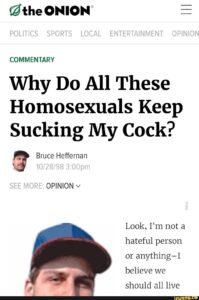
Anyway, excluding any other analysis, Occam’s Razor would lead one to suspect that the latter chain of reasoning was correct over the former, and it also has the benefit of not requiring me to be a totally shit human being in order to be true.
Which is, of course, why my brain keeps telling me it can’t possibly be true. It seems I’m just trying to let myself off the hook and rationalize my ongoing terrible behavior. After all, if I believe it’s a genuine mental health issue I won’t have to give it up, stop being a lazy-ass, and go back to work. My brain, as has been mentioned, is not terribly helpful sometimes.
If one accepts the unlikely premise that spending the last two years working in an ICU during the worst pandemic in a century may have had an impact on my mental health, comfort can be taken in the knowledge that I am far from alone. Caillet et al. (2020)2 found the incidence of anxiety and depression among ICU caregivers were 48% and 16%, respectively, and PTSD symptoms were present in 27% of respondents. That was as of September and I suspect those numbers have not improved3.
I can’t say how this is all going to play out in the larger context but brought down to the level of one individual (if that individual happens to be me) I can make what I think are some very accurate short-term predictions.
But that is a story for another day.
1 This is the equivalent of saying the Pacific Ocean gets quite deep in some bits.
2 Caillet, A., Coste, C., Sanchez, R., & Allaouchiche, B. (2020). Psychological Impact of COVID-19 on ICU Caregivers. Anaesthesia, critical care & pain medicine, 39(6), 717–722. https://doi.org/10.1016/j.accpm.2020.08.006
This in-line citation is really problematic. What kind of maniac has both in-line citations and endnotes? This is exactly the kind of societal collapse I’ve been warning about. My only excuse is that my school uses APA format (in-line citations) and virtually all the journals and whatnot I read use AMA (endnotes). That said, no excuse can justify this. I’m a monster.
3 The only reason I’m even a little uncertain about the current rates of depression, anxiety, and PTSD being worse or better is I can’t exclude the possibility that all the people predisposed to those conditions have already washed out which would make the percentages look better in spite of the overall situation being worse.
Too sane to be insane. Too insane to be sane. Love ya bro
I’m amazed at the hoops otherwise rational human beings are willing to jump through to convince themselves that they are walking sacks of garbage. Including myself, though my reservoir of trauma is much, much lower than that of many people. The Trauma Geese don’t even bother stopping by on their migration…
Please don’t attempt to prove yourself a better person than part of you wants to admit by driving yourself into the ground, figuratively or literally. Apply your own oxygen mask before assisting others. And FFS, don’t smoke in the lavatory.